Candy Crush and Royal Match are the two match-3 games almost everyone has played on a phone: swap two pieces, line up three, watch the board fall into place, beat the level’s goal before the moves run out. Both are apps. The idea behind them runs perfectly well in a browser tab, with nothing to install.
Below are six free games similar to Candy Crush and Royal Match, ordered by how close they are. The first one is a real swap match-3; the others each keep one part of the formula and change the rest. Every one of them is our own game, not an official Candy Crush or Royal Match, and none is made by King or Dream Games. The honest difference is written under each.
What Candy Crush and Royal Match actually are
Both games use the same move: swap two neighbouring pieces, and if that makes three or more of the same in a row or column, they clear and the pieces above fall to fill the gap. A level gives you a goal and a fixed number of moves. Bigger matches make special pieces, and the shapes that make them are nearly identical in the two games:
| Match shape | Candy Crush | Royal Match |
|---|---|---|
| Four in a line | Striped candy, clears a row or column | Rocket, clears a row or column |
| L or T shape | Wrapped candy, a bomb | TNT, a bomb |
| Five in a line | Color bomb, removes one colour | Light ball, removes one colour |
Royal Match also turns a 2×2 square into a propeller that flies off to a target.
The differences are in everything around the board. Candy Crush keeps score: a level awards one to three stars by points, and the levels sit on a long winding map. Royal Match has no score at all. You only have to finish the goals, every win pays one star, and you spend those stars on rebuilding and decorating a castle, one task at a time. Both games use lives: lose a level and you lose one, and when they run out you wait for them to come back.
So a real relative needs three things: the swap move, level goals inside a move limit, and special pieces made from bigger matches. A Royal Match relative also needs the meta, something you build with your wins.
Try it: how many moves does a board give you?
Every match-3 board hides a number: how many of the possible swaps actually make a match. The board below counts them for you. Change the number of jewel colours and watch what it does to your options.
Tap a jewel, then a neighbour, to swap them. The count below is every legal move left on the board.
Tap a jewel, then a neighbour, to swap them.
Show moves marks the edge between two jewels that make a match when swapped; gold marks a swap that would make a special piece. We filled 20,000 random boards of this size for each colour count, with no ready-made matches, and counted. Four colours left about 33 legal swaps on average, five colours about 23 and six colours about 17. A swap that makes a special piece was there on 99.6% of four-colour boards, 95% of five-colour boards and 85% of six-colour boards. Without the 2×2 square rule that last number falls to 68%: the square adds few moves, but it adds a lot of specials. This board clears matches and refills; it does not keep the special pieces.
Two things to take from that number. First, the colour count is the quiet difficulty dial of every match-3: a level with one more colour is far tighter even with the same number of moves. Sunken Jewels, for example, uses four jewel colours on its first two levels and five after that. Second, special pieces are not rare luck. On a normal five-colour board there is almost always at least one swap that makes one; the skill is seeing it before you take the plain three.
How close each one gets
| Game | How you make a move | Goals and move limit | Special pieces | Biggest difference |
|---|---|---|---|---|
| Sunken Jewels | Swap two neighbours | Yes | Four kinds, plus combos | Treasure floats up instead of falling |
| Flipfall | Tap a group of 2+ | Yes | A bomb from 5+ | No swaps; you spin the whole tray |
| Bubble Shooter | Aim and shoot a bubble | Clear the board | None | Aiming, not swapping |
| Mystic Match | Tap a free tile | Four of a kind in a box | None | A tray to manage, not a grid |
| Tape Match 3D | Peel a strip | Three of a colour, a timer | Tools, not pieces | A 3D parcel and a clock |
| Hexa Clue Sort | Swap two objects | Satisfy every clue | None | A logic puzzle on a honeycomb |
The closest: a real swap match-3
1. Sunken Jewels: the closest to both
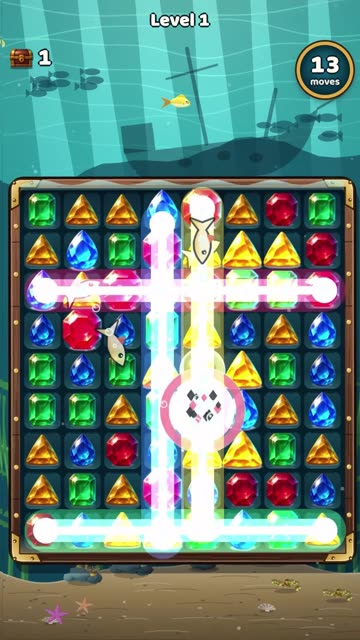
This is the one to play if you want Candy Crush or Royal Match in a browser. The board sits in the hold of a sunken ship, eight jewels wide. Swipe a jewel into its neighbour, or tap two neighbours, and three or more of the same in a line shatter while the jewels above fall to fill the gap. Rubies, sapphires, emeralds, topazes and amethysts each have their own cut, so you can tell them apart by shape as well as by colour.
The specials follow the shapes from the demo above: four in a line makes a Jet that clears a line, an L or T makes a Sea Mine, five in a line makes a Whirlpool that takes every jewel of one colour, and a 2×2 square makes a Darter, a little fish that flies off and hits whatever the level still needs. Swap two specials together for a bigger blast.
The twist runs the other way from Candy Crush’s ingredient levels. There, cherries and hazelnuts have to reach the bottom of the board. Here, treasure is buried on the seabed: make a match beside a chest or an amphora and it breaks free, rides a bubble up through the falling jewels and pops out at the surface. Each level asks for a few treasures, sometimes with a second goal such as clearing sand, inside a set number of moves. Later levels add nets, coral that spreads if you leave it, currents that slide whole rows sideways and chained treasure.
The Royal Match parts are all there too. Every win pays a star, and stars rebuild an old fishing harbour one job at a time with Nell, the harbour keeper: pier planks, market stalls, a boatyard crane, a lighthouse lamp. Some levels are marked Hard or Super Hard and pay two or three stars. Pearls buy four boosters that do the same jobs as Royal Match’s in-game ones: the Harpoon clears one cell, the Anchor a column, the Gale a row and the Tide reshuffles the board. Every win also turns up a curio for a museum of objects from the wreck, and a run of wins in a row starts the next board with specials already on it.
What it leaves out is lives. There are no lives and no timers: run out of moves and one tap starts the level again.
Same: the swap, move limits, goals, four special shapes, stars that build a town. Different: treasure rises, no score, no lives. Swipe or tap, mouse or touch.
Match-3 with a different move
These keep the colour-matching and the move budget but replace the swap.
2. Flipfall: tap groups, then turn the board
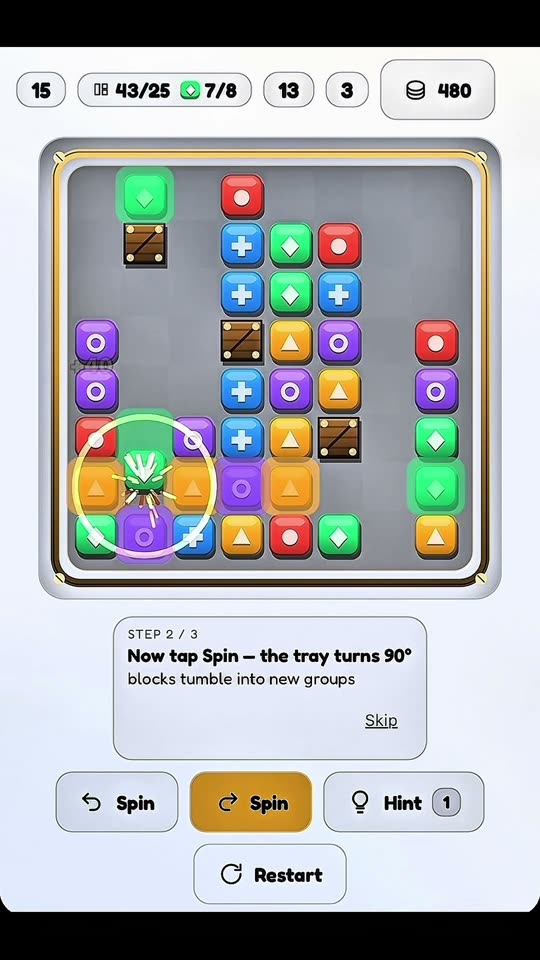
A collapse puzzle, the “tap to blast” branch of the family: tap any group of two or more touching tiles of one colour and it pops, and everything above falls. Each level has a goal chip (clear this many tiles, collect this much of one colour) and a budget of moves, exactly like a match-3 level. From level fifteen, popping five or more leaves a bomb that blasts its whole row and column. The twist is the brass tray: spin the board a quarter turn and gravity comes from a new side, which is how you push colours together and steer gems down to the floor.
Same: colour groups, goals, a move budget, a bomb special. Different: you tap groups instead of swapping, and spins are part of the plan.
3. Bubble Shooter: match three by aiming
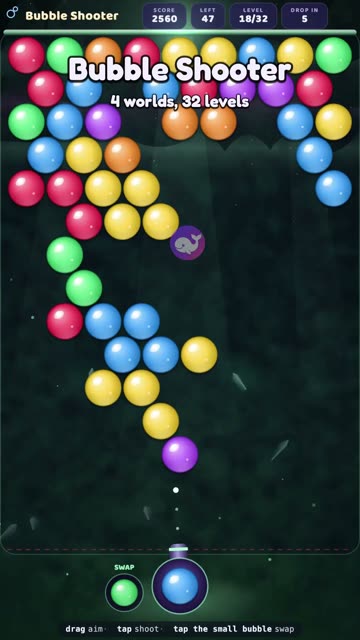
The oldest relative on this list. Coloured bubbles hang from the ceiling; you fire one from the bottom, and three or more of a colour that touch pop. Anything hanging below a popped group falls too, which is where the big clears come from, and shots bounce off the side walls so an awkward colour is usually one bank shot away. The levels run through four worlds and keep coming after that, and the ceiling creeps down every few shots.
Same: match three of a colour, levels to clear. Different: you aim instead of swap, and there are no special pieces. Mouse, touch or keyboard.
The tile-match side of the family
Many players who search for games like Candy Crush also play the “tile match” games, where you collect sets of the same picture into a tray. These two are that family.
4. Mystic Match: collect sets before the tray fills
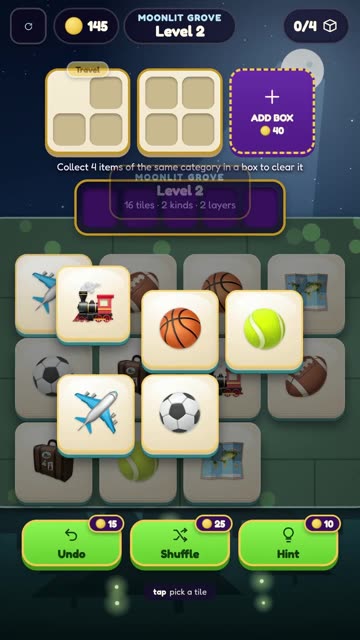
Tap a free tile and it flies to the box for its kind; four of a kind clear the box. With no box free, the tile waits in a five-slot tray, and if the tray fills up you are stuck. Four worlds add veiled tiles that only show their picture once nothing sits on top, boards stacked several layers deep, and three stars for a level cleared without help. The levels never run out.
Same: matching sets, level after level, three stars to chase. Different: no grid and no swaps; the puzzle is the tray. Calm, no clock.
5. Tape Match 3D: three of a colour, on a 3D parcel
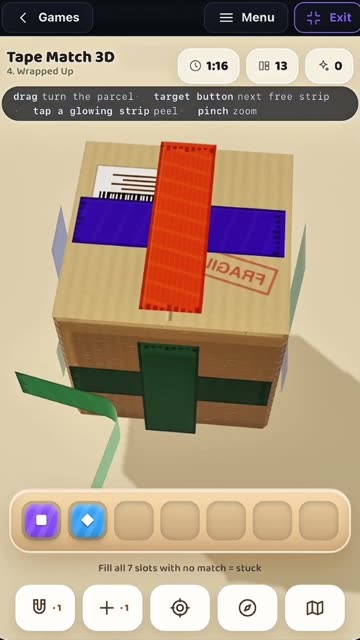
Strips of coloured tape cover every face of a parcel. Turn it, peel a free strip into your tray, and three of a colour clear. The ones you need are often on the side you cannot see, and pinned strips cannot be pulled until the strip on top is gone. Unlike everything else here, a timer runs, so sometimes a decent peel taken quickly beats a perfect one.
Same: match three of a colour, a tray that can jam. Different: 3D, and a clock.
The swap move, as a logic puzzle
6. Hexa Clue Sort: swap until every clue is happy
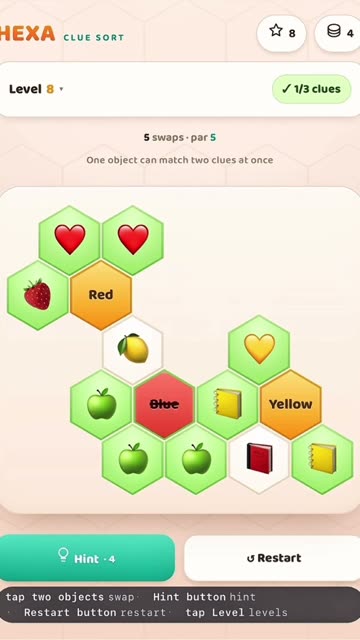
Tap two objects on a honeycomb to swap them, the same move as Candy Crush. But nothing clears and nothing falls: gold clue hexes each ask for a colour or a kind, and you win when every object touching each clue fits it. One object can satisfy two clues at once, and the later boards are built around finding those overlaps. No timer; each level has a solution.
Same: the swap. Different: a logic puzzle, not a falling board.
If you want the real thing
Candy Crush Saga is made by King and Royal Match by Dream Games. Both are free-to-play apps for phones and tablets with optional purchases, and Candy Crush Saga is also available for Windows PCs. If you want the official versions, get them from your phone’s app store or the official sites, not from a site that claims to host them. Everything on this page is a different game that shares the genre.
What “but better” usually means
People who search for a Candy Crush “but better” usually mean one of three things, and it is worth knowing which one before you pick:
- No waiting. Lives are the most common complaint: lose a few levels and you wait or pay. Sunken Jewels has no lives, and none of the other games here has a lives system either.
- No score chasing. If you like Royal Match because it only asks you to finish the goal, Sunken Jewels works the same way: goals and moves, no score target.
- Something to build. If the castle is the reason you play Royal Match, the harbour in Sunken Jewels is the same loop: one star per win, one job per star or two.
Habits that carry over
Whichever game you pick, four match-3 habits still work:
- Look for the special before the goal. As the demo shows, a swap that makes a special is almost always on the board. One Jet or rocket often does more for the goal than three plain matches.
- Match low when you can. A match near the bottom moves more of the board, and falling pieces make their own matches. In Sunken Jewels it also opens the shaft above a buried treasure.
- Combine specials. Two specials swapped into each other do far more than the two fired one after the other.
- Spare moves are worth something. In Sunken Jewels, moves left over when the last treasure surfaces turn into Jets that pay extra pearls, so finishing early pays.
More grid puzzles are on the Puzzle page. If you like the board-filling side of these games, our lists of games like Block Blast and games like Suika Game have more.