 ArcadeWhale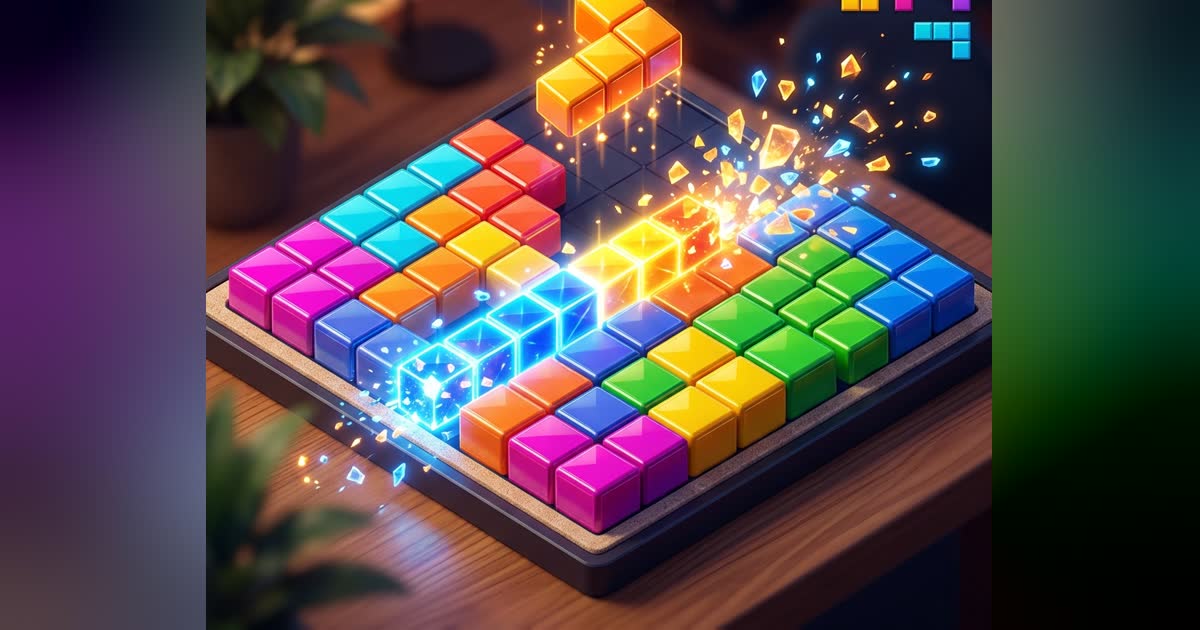
Block Blast is one of the most-searched games on the planet right now, and what people are searching for is a feeling: pieces in your hand, a grid that is filling up, a line that clears with a satisfying crack. The app is on phones. The feeling is older than phones, and it runs perfectly well in a browser tab with nothing installed.
Here are seven games that scratch the same itch, sorted by how close they are to the original. None of them is a clone; each one takes one part of Block Blast — placement, line clears, the tidy-the-board pressure — and does something with it. The honest differences are listed under each.
What Block Blast actually is
Eight-by-eight grid. Three pieces at a time, drawn from the tetromino-and-friends family. Drag a piece onto the grid; complete a row or column and it clears; combos for clearing several at once. Pieces do not rotate, nothing falls, there is no clock, and the game ends when none of your three pieces fits anywhere. It is Tetris with the gravity and the timer removed — a pure placement puzzle.
That gives us three things to look for in a relative: piece placement on a grid, line or group clearing, and the board-management pressure that comes from having to keep space open.
1. Loop Blocks — the closest match
Drag pieces from a tray onto a board; fill a row or column and it clears. So far, Block Blast. The twist is where the cleared blocks go: they ride a conveyor loop around the board into goal slots, and you win a level by filling every goal. Pieces can rotate here (click to turn), which is a big difference from the original, and levels have an end rather than going forever.
Same: placement, line clears. Different: rotation, level goals. Mouse or touch.
2. Block Bloom — placement as a jigsaw
Polyomino pieces in a tray, a board to tile exactly, and a hidden picture that blooms when you do. No lines clear — instead the puzzle is to fit every piece within a move budget so the board is completely covered. If what you love about Block Blast is the moment a piece slides into the only gap it could possibly fill, this is that moment, level after level.
Same: pieces on a grid, tight fitting. Different: no clears, finite levels. A green preview shows when a piece fits.
3. Flipfall — clear groups, then turn the board
A collapse puzzle: tap a group of two or more matching tiles to pop it, and the tiles above fall. Then the twist — spin the whole tray ninety degrees and gravity comes from a new side, and the timber blocks that turn with it steer the gems where you want them. It has the same “keep the board alive” tension as Block Blast, with the placement replaced by rotation.
Same: clearing, board pressure, no timer. Different: you remove rather than place. One hand.
4. Shift Out — the 2048 move on a Block Blast board
Swipe and the whole board slides; matching tiles that reach their coloured gate eject through it. Clear every tile within the move limit. The relative here is the sliding — one input moves everything — and the puzzle of doing it in the fewest moves.
Same: grid, clearing, move budget. Different: nothing is placed, everything slides.
5. 2048 — the other grid puzzle everyone knows
Not a block game, but the same audience plays both and for the same reason: one simple rule, a board that fills, and a decision every move about whether you are making things better or worse. Arrow keys or swipes. If you have never reached 2048, the corner strategy is a five-minute read.
Same: grid, merge-to-clear, endless score. Different: numbers, not shapes.
6. Pastry Pile — drop-and-merge with physics
Drop pastries into a tray; two matching ones that touch merge up an eleven-step chain. It is the “watermelon game” family rather than the block family, but it shares the core pleasure: a board filling up, a merge that clears space, and a chain you are trying to complete before the pile reaches the top. Twelve shifts, timed rush waves, four awkward shapes of dough.
Same: board pressure, merge clears. Different: physics, round shapes, no grid.
7. Hexa Clue Sort — a hex grid and a logic twist
A honeycomb instead of a square grid. Swap objects across it so that every gold clue hex is satisfied — and one object can satisfy two clues at once, which is where the clever chains come from. It is a puzzle first, a block game second, but the hex grid is the same shape Block Blast’s hexagonal cousins use.
Same: grid, tidy-the-board logic. Different: swaps, not placements; each level has a solution.
If you want the real thing on a computer
Block Blast is a mobile app; the browser has always had its own versions of the same idea. 1010! is the direct ancestor — a 10×10 grid, three pieces, no rotation — and Woodoku adds Sudoku’s 3×3 boxes as a third thing to clear. Both are widely available as web games. And Tetris itself, which the whole family descends from, has a free official browser version at tetris.com.
Strategy that carries over
Whatever you pick from this list, three habits from Block Blast still apply:
- Place the ugly piece first. The 3×3 square and the long bar are the ones that end games. Put them down while the board is empty; the small pieces fit anywhere later.
- Never make a one-cell hole. A single empty cell can only be filled by a single-cell piece, and you may not see one for a long time.
- Build from the edges, keep the middle open. Full rows form naturally along the walls; the centre is where you need room for whatever comes next.
All seven are on the Brain Benders and Sort It Out shelves, along with the rest of the grid puzzles.


