Arcade Whale
Geometry Dash is the game most people picture when they hear “one-tap rhythm game”. RobTop Games released it in 2013, and the idea is easy to explain and hard to do: a small cube slides to the right by itself, the level is full of spikes and blocks lined up with the music, and the only thing you do is jump. The attempt counter in the corner climbs into the hundreds, and somehow that is part of the fun.
The full game is a paid app, and the free Lite version only has some of the levels. Neither one runs on a school Chromebook that cannot install apps, and neither one is a quick tab you can open at work. That is where browser games help. We don’t host Geometry Dash, and nothing on this page is the official game. What we have are four games built on its best ideas: one button, a course that is learned by heart, and a beat or rhythm you can feel. All four open in a normal browser tab with no download.
Before the list, a quick test of the skill all of them share.
Try it: can you tap on the beat?
In a rhythm runner, the spike is not the signal. The beat is. Press Start, listen to the four count-in clicks, then tap on every beat that follows: press Space, click the stage or touch the big button. The test runs for twelve beats and then shows how early or late each tap was.
Tap on the beat: 12 beats
Press Start. The first four clicks are a count-in, then tap on each beat.
The demo counts a tap within 50 milliseconds of the beat as on the beat, which is our own choice for this test. Wireless earbuds add a delay to the click, so if every tap comes out late, try following the flashing line instead of the sound. 120 BPM means one beat every half second, and 140 BPM is the tempo of Boing Beat's last level.
Most people who try this for the first time lean late, because they wait for the note to reach the line and only then react. Reaction takes time, so the tap lands after the beat. Players who clear hard levels tend to do the opposite: they hear where the beat will fall and press with it. That is the whole difference between dying on a spike and floating over it, and it is the skill all four games below train.
1. Boing Beat: the closest one
Boing Beat is a one-tap rhythm runner, so it sits closest to Geometry Dash on this list. A round, wide-eyed blob bounces to the right on its own through a bright side-on world, and every level has its own song. Every obstacle sits on a beat of that song. Tap on the beat and the jump carries you over the spike, onto the block or across the pit. You can play by eye, but it is easier by ear, and the floor tiles and the scenery pulse in time to help.
Holding works too. Hold the button instead of tapping and the blob jumps again each time it lands, which is how you cross a long row of spikes: hold through the row and let go once the ground is clear. Touching a spike, running into the side of a block or dropping into a pit ends the attempt, and the level restarts almost at once. An attempt counter sits at the top, with a progress bar that marks your best run, so the Geometry Dash ritual of “one more attempt” is all there.
There are 21 levels in seven worlds, and each world adds one new thing. Dunes brings yellow springs that launch you on their own and golden rings where a tap in mid-air gives you a second jump. Lagoon has blue gates that flip gravity so you run along the ceiling. Night has green gates that speed you up and orange ones that slow you down, and the gaps change while the beat stays the same. Sky puts you in a bubble that you hold to raise and release to sink, and Disco has lifts that bob with the music. The final level throws all of it at you at 140 beats per minute.
Each cleared level pays up to three music notes: one for any clear, two for a clear in a single run without a checkpoint, and three if at least seven of every ten jumps landed right on the beat. That third note is where the timing test above stops being a toy.
2. Leap: for the part where you die a lot
Some Geometry Dash players are really there for the hard part: the stretch you replay fifty times until your hands know it. Leap is built for that feeling, without the music. It is a precision platformer made of 91 single-screen rooms, and every room fits on one screen, so the spikes that kill you, the springs that throw you and the door you need are all visible from the first frame. You die because you misjudged a jump, never because of something hidden around a corner.
The jump is built to be trusted. Hold the button longer to jump higher. You can still jump for a moment after running off a ledge, and a jump pressed just before you land fires the instant you touch down, so a death almost always means distance, not a missed frame. Walls are a second way to move: hold toward a wall and jump to climb it, or let go and jump to leap away from it.
Eight worlds each add one idea. Spikes arrive in world two, wall climbing in three, springs in four, crumbling ground in five, ice in six, locked doors with keys in seven and wind in eight. Five one-off rooms bend a rule once, from darkness to low gravity. Stars reward clean runs, three for one death or fewer, and the shop only sells skins. Nothing you can buy makes a jump easier, which keeps every clear honest.
3. Mesa Drift: one button, a road instead of a beat
Mesa Drift takes the one-button idea onto a road. A small car drives itself along a narrow zigzag road floating above red desert mesas. Hold the screen, the mouse button or Space and the car swings right; let go and it swings left. That is the whole control.
The 32-second clip is two runs: the first falls off at 248 m, the second makes it to 683 m.
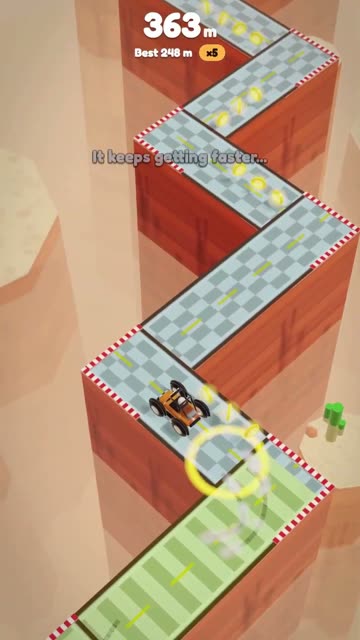
The car does not turn on the spot. It keeps sliding in its old direction for a moment before the tyres grip, so every corner is a short drift. Turn too early and you cut the inside and drop off the edge, too late and you slide wide. The road is built from patterns with a rhythm: a long straight to breathe, then a staircase of three to five quick bends, then another straight. Later come broken staircases that mix short and long steps, so you have to read the road instead of tapping a beat, which is the same lesson Geometry Dash teaches when a level changes speed.
Take a corner through the middle of the road and it counts as PERFECT. Three in a row double every coin you pick up, and a longer streak raises it to five times. Your first three minutes are practice, so a fall just puts the car back on the road.
4. Papercut: one button, choosing your height
Papercut is a one-button arcade game set inside a toy paper theatre. You are the blade, a spinning rotary cutter crossing the stage from left to right while paper scenery hangs and stands in the way. A short press flips the blade upward and gravity brings it back down, so the only thing you ever decide is your height. If you liked the ship sections of Geometry Dash, where you hold to rise and release to fall, this is that feeling turned into a whole game.
Holding the button turns the blade gold and makes it spin heavy, which cuts through brown card but also drags you down faster. Every piece of card asks the same question: is this cut worth the height it costs? Seven acts each add one new material. Yellow tape cuts but kills your climb, a green paper coil launches you up, and blue-grey staples end the run, unless you tap at the exact moment you touch one, which bounces you off it. That last trick is the closest thing here to hitting a jump orb on the beat.
How to beat the part you keep dying on

- Jump on the beat, not on the spike. The jump carries you over at the top of its arc, so the tap belongs a moment before you reach the obstacle. If the test above showed you leaning late, this is your fix.
- Hold through rows. In Boing Beat a held button bounces you every time you land. Hold before the first spike of a row and let go once the ground ahead is clear.
- Use the practice flags, then drop them. Boing Beat switches checkpoint flags on after two failed tries without progress. Learn the hard part with flags, then clear the level in one run for the second note.
- Read the pattern, not the screen edge. In Mesa Drift and Leap the next move is visible early. Look one obstacle ahead, so your hands are already doing the current one.
- Stop after a good run, not a bad one. Muscle memory sets in between sessions. If you have died twenty times on the same spike, a short break often does more than attempt twenty-one.
More one-button games, from tower smashing to knife throwing, are on the One Button page, and Smash Tower and Thunk both run on a single press. If you play at school, our list of games for a Chromebook has quiet, trackpad-friendly picks, and fans of endless courses should try the games like Slope.