Arcade idle is the mobile genre where you walk a little character around, things stack up on your back, and you carry them to a counter where customers pay. The cash drops on the floor, you walk over it, and you spend it by standing on a pad until a new station, a new area or a new member of staff appears. Most of these games are phone apps. The idea works just as well in a browser tab, with nothing to install.
Below are the two arcade idle games we make that run free in a browser, Meat Camp and Whale Bay, how each one plays, and a calculator that shows what one full trip is worth in Meat Camp. After that comes a short list for people who mostly like the management side. Every game here is our own game, and none of them is affiliated with the mobile hits named on this page.
What an arcade idle game is
The name sounds like a contradiction, and it describes the two halves of the game.
The arcade half is that you move a character yourself, with a joystick on a phone or the keys on a computer. Nothing happens from a menu. You stand next to a source (a fishing spot, a tree, a field of animals) and the goods pile onto your back. You walk to a station and they pour off. Customers queue there and pay, and the money lands next to the counter as a pile you have to go and collect. My Perfect Hotel and Burger Please are well-known examples, and hunting games in the style of the Whiteout Survival ads use the same loop with animals.
The idle half is staff. Every repeated walk can be bought off: a cashier who handles the money, a worker who carries goods from one station to the next, a second gatherer. Each hire frees you to do the next, longer walk yourself, and the staff keep working when you look away. The money goes on buy pads on the floor: you stand on one and the coins drain into it until it is paid, and the station, gate or helper it shows appears on the spot.
That is the whole loop: gather, carry, sell, collect, buy, hire, move on to the next area. What makes one arcade idle game better than another is what gets in the way of the walk. If you would rather skip the walking and just watch numbers grow, our idle games post covers the pure idle and incremental kind.
How they compare
| Game | What you carry | Where it goes | Who you can hire | While you are away |
|---|---|---|---|---|
| Meat Camp | Steaks, logs, hides and coins | Fire Pit, Smokehouse, Stew Pot, woodshed, Tannery, the trader’s sled | Hunter, cook, cashier, runner, woodcutters | Up to 8 hours, once you have a crew |
| Whale Bay | Fish, feed and cash | Seven aquarium tanks and a ticket booth | Cashier, feeder, fisher | Up to 2 hours, once you have a cashier |
1. Meat Camp: a tower of steaks in the snow
Meat Camp is the arcade idle loop with something trying to take your load. A small log camp sits at the bottom of a snowy valley, villagers queue at the counters, and north of the fence the valley climbs through four zones: an open meadow, the pine woods, the Elk Grove and Bear Ridge. You play a hunter in a blue parka. You only walk, with W A S D or the arrow keys, or by dragging on a phone. Walk into an animal and your axe swings by itself.
Every animal you bring down drops steaks that jump onto the frame on your back: a hare gives 2, a wolf 4, an elk 11 and a polar bear 30. Whatever does not fit is left on the snow. You start with room for 12 steaks, and the Bigger Pack pads raise that step by step to 140. The steaks stack into one tall tower that leans when you turn and wobbles when you stop short. Take a sharp turn with a heavy load, dash or get hit, and the top steaks spill. You can pick them up again, but not forever. Pack Rope steadies the tower.
In this 26-second clip you axe an elk, carry the steaks home as a swaying tower and hold the fence.
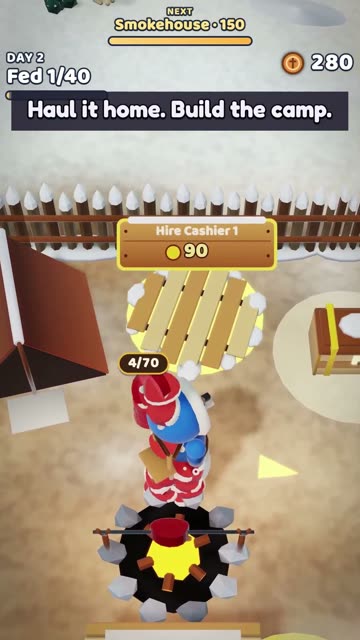
Back in camp you drop the meat at a station. The Fire Pit turns one steak into a skewer, the Smokehouse turns two into a smoked ham and the Stew Pot turns three into a bowl of stew, which pays the most per steak. Villagers take the food and pay, but the coins fall in a pile beside the counter, exactly like cash in the mobile games. Walk over the pile to carry it, then bank it in the camp chest or spend it on the spot. A pad takes the coins you carry first, then the coins in the chest, and a ring fills around it before any money flows, so walking past a pad by accident costs nothing.
The animals fight back. This is what separates Meat Camp from a calm arcade idle game. Each attack is drawn on the ground before it comes: a red line where a wolf will lunge, a red cone behind an elk that kicks, a long red lane for a charging polar bear. Press Space or tap DASH to jump out of the red. Stay in it and you are knocked down, and something comes loose: part of your tower, the coins you carry, or your axe. Carrying coins through the valley is a real risk, which is why the cashier is one of the first hires.
The crew. Pads hire a helper hunter, a cook who makes the best counter cook twice as fast and pay more for every dish, a cashier who carries the coin piles to the chest, and a runner who takes meat from a rack by the gate to whichever station needs it. With a runner you can drop the whole tower at the gate and head straight back out. Later, woodcutters fell birches and fill the woodshed for you.
The nights. Every few days a blizzard rolls in. The gates shut and wolves gnaw at the fence, slip in where a log breaks and steal from your stations. Hold the fence until dawn for a bonus. After your first blizzard a pad opens the Timber Grove, a birch wood where your axe fells trees for logs. Logs ride on your back with the meat, and a stocked woodshed makes every station cook half again as fast and lights a bonfire at the fence on blizzard nights.
The camp grows. From the fourth day a trader parks his sled outside the north gate and asks for raw steaks. He pays in goods, not coins: fill the order and a crate gives you a Golden Axe, Snowshoes, Sled Dogs that let you carry half again as much, or a Spice Sack that makes every dish pay half again as much until dawn. Every steak on his sled is a steak the villagers never eat, so each trip home is a choice. Once the Elk Grove is open you can expand the camp: the old palisade comes down, a wider one goes up and a Great Fire burns in a new plaza. It eats logs every night, and its circle of light is safe ground on blizzard nights. A Tannery turns hides into leather, and a Fur Stall sells coats that pay more than stew.
The first big goal is the Great White Bear on Bear Ridge, which comes on a blizzard night of its own. After it falls the Meat Festival opens a second act: red foxes that sneak up and snatch steaks off a tall tower, a Trophy Arch that lets you hire every crew member a third time, and the Winter Feast as the last goal. Past the arch there is more to build: a Gate Market that buys spare steaks, logs and hides for coins, ice fishing on the West Creek for a Fish Hut that cooks chowder, and tower plots where you choose a Bow Tower or a Spear Ballista that shoots by itself on blizzard nights.
While you are away: with at least one crew member hired, come back after ten minutes or more and the crew hands over what they earned, for up to eight hours. Nothing attacks the camp while you are gone.
Try it: what is one trip worth?
The core of every arcade idle game is one sum: how much you can carry, times what each piece is worth where you drop it. Pick a pack and a counter below. The squares are your tower; each colour band is one dish, and grey squares are steaks left over that do not make a full dish. The numbers are Meat Camp’s own prices and payouts.
How many full trips does the next pad cost?
A full tower of 12 steaks makes 12 skewers at the Fire Pit and pays 48 coins.
Payouts: a skewer pays 4 coins for 1 steak, a smoked ham 12 for 2 and a bowl of stew 22 for 3. A hired cook makes his counter's dishes pay 30% more, a Spice Sack 50% more until dawn, and Sled Dogs let you carry half again as much until dawn; each dish is rounded to whole coins, as in the game. The last pack level needs the Trophy Arch first. A real trip pays a little less than this: steaks spill on sharp turns, wolves knock some loose, and villagers have to come and buy. What the calculator gets right is the order. A bigger pack and a better counter pay for themselves in a handful of trips, which is why they come first.
Two things stand out once you play with it. The first pack upgrade costs 15 coins and pays for itself on the very first trip, and the step from 48 to 70 steaks costs 560 coins and pays for itself in four trips to the Stew Pot. And the counter matters as much as the pack: the same 12 steaks pay 48 coins as skewers and 88 as stew. That is why the Stew Pot, at 500 coins, is one of the best buys in the game.
2. Whale Bay: an aquarium you stock by hand
Whale Bay is the calmer one, and the closest to the hotel and burger games on phones. You run a seaside aquarium in cheerful low-poly 3D, starting with one sardine tank, a fishing pier and a ticket booth. Drag anywhere or use W A S D to walk. Stand at the pier and fish fill the basket on your back; you start with room for 6 and the Stack Size upgrade adds 2 a level. Walk to an empty tank and the fish pour in, and once it holds enough, the tank comes alive. The sardine tank needs 8.
Living tanks bring visitors. Until you hire help you stand behind the ticket booth to serve them, and they also tip at the tanks they like, so cash piles up on the boardwalk for you to walk over. Glowing pads take payment while you stand on them, and they accept part payments, so you can split your cash between two things. The park opens up in four areas, from the Harbour through the Reef Walk and the Deep Cove to the Whale Lagoon, and seven tanks lead from sardines and clownfish through jellyfish, manta rays, sea turtles and reef sharks to the whale.
The crew: a Cashier sells tickets while you are away from the booth, a Feeder keeps the tanks fed from the feed mixer and a Fisher catches and stocks fish for new tanks. The cashier is the cheap one, at 220, about what the second tank costs, and it is the hire that matters most: with a cashier the park keeps earning for up to two hours while the tab is closed, and without one it earns nothing. Run Speed, Stack Size, Catch Rate and Ticket Price upgrades shorten the rest of the walking.
The goal: the whale. When it arrives in the lagoon you can stand by the whale statue to start the next season, which brings a new star tank and multiplies what the park earns.
There are no attacks here, and nothing spills. If Meat Camp sounds too hectic, Whale Bay is the one to start with.
If you like the management part
Some people play arcade idle games for the walking and the stacking. Others like the part where a shop grows, every station changes what you can do, and you decide what to buy next. If that second part is your favourite, these are worth a look, with one honest difference: in neither of them do you walk a character around.
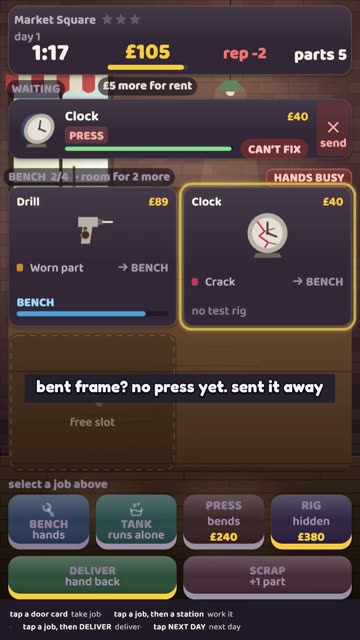
Fixworks is a repair shop you run one working day at a time. People walk in with broken things, you pick which jobs to take, and you click a job and then a station to work on it. The shop opens almost empty, and every station you buy changes a rule rather than a number: the press lets you take bent frames at all, and the test rig finds faults the customer never mentioned. Rent comes out of the till at closing and goes up every single day, so the score is how many days you keep the doors open, across three streets with up to three stars each.
Firecrust is a wood-fired pizza counter over eighteen nights in three shops. Customers queue with their own patience, like the villagers at Meat Camp’s counters, but here you build every pizza yourself while the last one bakes behind you. It is the counter half of an arcade idle game, made into the whole game.

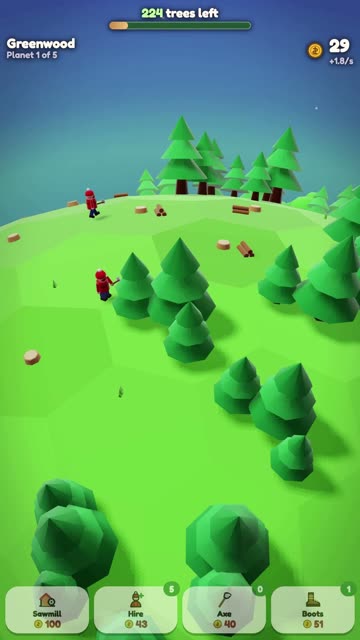
The idle planet games sit on the other side. In Timber Planet a lumber crew carries every log home on their shoulders and it only pays when it arrives, so placing the sawmill near the trees is the same “shorten the walk” decision as hiring a runner in Meat Camp. You tap instead of walking, though, and the game keeps going on its own. It and the other idle games are in our idle games post.
Tips that work in any arcade idle game
- Buy carrying room first. Every trip pays for what you can carry, so the first bag, basket or pack upgrades pay back fastest. The calculator above shows how fast.
- Hire whoever handles the money. A cashier is cheap in both games here, and it is what keeps the park or the camp earning while you are away.
- Feed the counter that pays most per piece. In Meat Camp that is the Stew Pot for meat; three steaks there are worth more than three skewers.
- Do not carry more than you can protect. A tall tower in Meat Camp spills on sharp turns and draws foxes in the second act. Head home a few steaks early when wolves are around.
- Spend before you leave. Crew earnings while you are away come from the crew you have, so buy the next hire right before you close the tab.
Where to start
Start with Meat Camp if you want the full arcade idle loop with some danger in it: a tower that sways, animals that charge, blizzard nights and a camp that keeps growing for hours. Pick Whale Bay if you want the calm version, where the only thing between you and the next tank is the walk. Both open in a browser tab on a phone or a computer, with no download and no account, and both remember your progress on that device.