Castle games come in three kinds. In one you knock a castle down. In another you hold a castle while something walks at it. In the third you plan the defense piece by piece before the wave arrives. All three work well in a browser tab, and this page has free ones of each, with nothing to install.
The lead pick is Castle Barrage, a turn-based artillery duel where your castle and an enemy castle trade rocket salvos across a mountain. Right after it there is a small artillery toy you can play on this page. Then come a keep to hold and two defense games to plan. Every game here is our own, and where one is only loosely a castle game, we say so.
The quick version
| Game | What you do | The castle | Pace | Controls |
|---|---|---|---|---|
| Castle Barrage | Knock down an enemy castle with rocket salvos | Yours on tank treads against theirs, four boss castles | Turn-based | Drag back and let go |
| Crowd Blaster | Storm a gatehouse with a crowd of soldiers | A red gatehouse, a fortress at the end of every world | Real time | Slide a cannon |
| Lonewatch | Hold a hexagon keep on six roads | Yours, from a wood fence up to towered walls | Real time, idle | Press glowing buttons |
| Thornwall | Plant a hedge maze around a crown | A vegetable garden, not a castle | Waves you start | Tap to plant |
| Circuit Defense | Wire defenses on two lanes to a core | A circuit board, not a castle | Waves | Tap to build |
Attack a castle
1. Castle Barrage: rocket artillery through ×10 gates
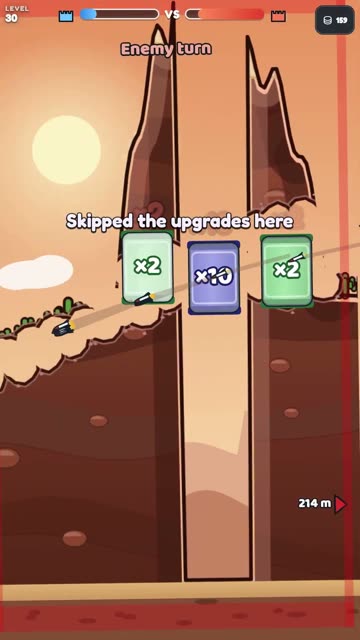
Your stone castle sits on tank treads at the left end of a wide valley. The enemy castle is far off to the right, past the edge of the screen, and a giant snowy mountain stands in between with blue gates stacked in a canyon inside it. You fire, then the enemy fires back, one turn each. It plays like the classic artillery games such as Worms or Scorched Earth, with one twist: every rocket that flies through a gate comes out multiplied, so six rockets can arrive at the enemy walls as sixty.
You aim every shot yourself. Press anywhere on the screen, drag back and let go: the direction of the pull sets the angle and its length sets the power, and a readout such as 45° 50% sits next to the barrel. A dotted line runs from the barrel to the first gate on your path, and that gate glows. The line stops there on purpose. It tells you which multiplier you will get, not where the salvo lands, so the second half of every shot is judgment. The faint trail of your last shot stays on screen with a mark where it came down, and the best shots usually come from a small correction to that trail. On a keyboard, the arrow keys or W, A, S and D set the angle and power and Space fires.
The best gates are inside the rock, so you dig your way to them. Every rocket blasts away the rock it hits, which means each salvo bores the tunnel a little deeper, and on later levels thick rock takes two salvos or more to break through. Gates run from ×2 up to ×10, and some lines have two in a row, so a ×10 followed by a ×5 turns one rocket into fifty. Red ÷2 gates halve whatever passes through them. The enemy castle’s rockets fly through the same gates and multiply the same way, which is why a level is a race to land the big salvo first.
The campaign has 60 hand-made levels over four worlds, Pine Pass, Red Mesa, Frost Fjord and Ember Peak, fifteen levels each. The last level of every world is a boss castle: the Iron Keep, the Sandstone Citadel, the Frost Bastion and the Magma Fortress. A boss castle is bigger, and two of its gunners fire on the same turn. After level 60 the levels keep coming, built from the later layouts and never the same one twice in a row. New ideas arrive every few levels:
- Gunners stand on the enemy walls and take turns. The loaded one glows red, and if you knock him down the enemy skips its next turn.
- Moving gates slide to a new spot every turn, and iron shields stop flat shots.
- Builders repair the enemy castle every turn, so you take them out first.
- Wind bends every shot and changes from turn to turn.
- A supply balloon gives you a bigger next salvo when you pop it.
- A rolling fortress drives to a new spot every turn, golden ×20 gates crack after a few rockets, twin keeps have two towers that both have to fall, and portals drop rockets straight onto the enemy roof.
Between levels: coins buy six upgrades in the Armory. Rocket Rack adds a rocket to every salvo, Warheads add 25% damage per rocket, Guidance makes the aim line longer and keeps the fans of rockets tighter after each gate, Armor adds 20% castle health, Drill Tips bore 25% more tunnel per rocket, and a Repair Crew fixes 3% of your castle every turn. The Castle tab next to it is a workshop for the stone of your walls, the shape of your towers, your flag, the emblem on your banner and the trail your rockets leave. Some wall styles only open when you beat a world’s boss. For your first three minutes of play, enemy rockets do about a third of their normal damage, so you can find your range without losing the castle.
The online duel: tap 1v1 Online on the home screen or on the strip at the start of a level, and an opponent is found in seconds. Both of you see your own castle on the left and the same mountain in the middle, with the gates in the centre of the canyon. There are no upgrades in a duel and every rocket counts the same, so aim decides it. If the player who fires first brings the other castle down, the other side still gets one last salvo, a little smaller than a normal one, and if both castles fall, the bigger final salvo wins. Wins, draws and losses all pay coins for the Armory.
If you found this game through the rocket-castle ads, we put it side by side with the ad in games that are actually like their ads.
Try it: aim a salvo through the gates
Every artillery game is a game about reading an arc. The toy below uses Castle Barrage’s gravity, its angle limits (6° to 84°) and its power range, and a starting salvo of six rockets like the game’s, on a small map of our own: a ×2 gate, a ×10 gate, a mountain and an enemy castle. Set the angle and the power, or drag back on the picture and let go, and see how many rockets reach the walls.
Six rockets leave the barrel. Every gate they fly through multiplies them, and after a gate they spread out in a fan.
45°
50%
Drag back on the picture and let go, or set the sliders and press Fire.
The faint lines are your last salvo, the way Castle Barrage keeps your last trail on screen. We fired the first rocket of a salvo at every whole angle from 6° to 84° and every power from 0% to 100% on this map, 7,979 shots in all. 175 of them reach the castle with no gate at all, 27 go through the ×2 gate alone, 31 through the ×10 gate alone, and only 14 through both for ×20. The ×20 shots sit in a thin band where the ×2 shots and the ×10 shots meet. This toy has no wind and no rock to dig through; in the game, the gates sit inside the mountain.
Two things to take from it. First, the same castle can usually be hit with a low arc or a high one. On flat ground, at the same power, a 30° shot and a 60° shot land in the same place; the high one just takes longer and comes down steeper. On this map the high lobs over the mountain are the easy hits, but they carry six rockets and nothing more. Second, the gate comes first. Find the angle that runs through the gate you want, then nudge the power until the multiplied fan still reaches the walls. That is the same order Castle Barrage teaches with its dotted line.
2. Crowd Blaster: storm the gatehouse
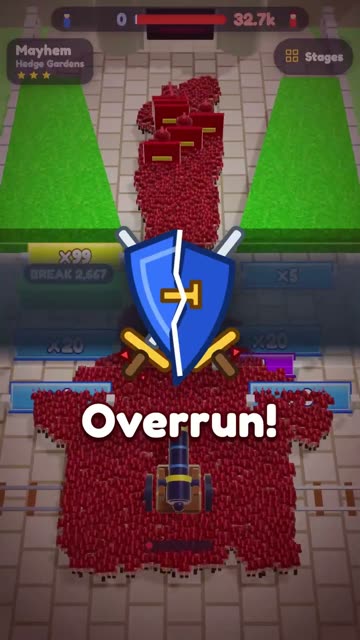
If aiming arcs is not your thing, Crowd Blaster attacks a castle with numbers instead. A wheeled cannon at the bottom of a courtyard fires little blue soldiers on its own, and you slide it left and right so the stream runs through ×2 and ×3 gates. At the far end a red gatehouse keeps pouring out its own army, and when the two crowds meet they knock each other out one for one, so the bigger crowd wins.
The castle part comes at the end of every world: the last stage is a fortress siege where you have to knock the red gate down. Some castles have twin doors that send the red army out of both sides at once, and Blitz stages give you a timer to take the fortress before it runs out. It is real time, not turns, and it is the furthest from a classic siege game on this page, but it is the one where the castle falls under a flood of hundreds.
Hold a keep
3. Lonewatch: a hexagon keep at dusk, six roads of undead
Lonewatch is the castle game for people who would rather watch the walls go up than aim anything. A small hexagon keep stands in 3D where six roads meet, and the undead walk in along those roads, wave after wave. You start with an empty courtyard and just enough coins for a first defense. Your defense shoots by itself, and every fallen enemy pays coins.
The whole game is a row of big buttons. A button glows when you can afford it, you press it, and the piece appears in the scene. There is nothing to place: when you press Walls, the game raises the side that is in the most danger, and weapons go to their own spots in the courtyard. Your only decision is what to buy next, and the enemies make that a real decision.
- Walls go up through fifteen kinds, from a Wood Fence and a Palisade through Iron Fence, Field Stone and Brick to Stone Rampart, Castle Wall, Towered Wall and beyond, ending at The Last Watch. Finish all six sides of one kind and the courtyard grows, and the camera steps back to fit it.
- Weapons come in six families: Archers, a Ballista whose bolts pierce a whole column, Gate Spikes that hurt whatever stops at your wall, a Catapult that lands boulders in a pack, Cannons that pick out the biggest foe on the road, and Frost Spires that slow every road. Each one changes its look as you level it.
- The undead push you to spread your coins. Zombies are slow and sturdy, skeletons run, and ghosts drift straight through walls, which is why archers still matter once the walls are stone. Every tenth wave a vampire leads the column, and every fiftieth a Vampire Lord. More roads wake up as the waves climb, until all six are busy at once.
Losing costs little. If the keep falls, everything you built stays and you go back three waves. Coins keep coming while you are away, for up to four hours, and a card shows what the keep earned when you return. On a keyboard, keys 1 to 6 press the same buttons; you can drag to look around and pinch or scroll to zoom.
Plan a defense
Tower defense is the planning side of castle games: the enemy walks a route, and you decide where the defense goes before it arrives. Neither of the next two games has a castle in it. They are here for the defense, not the stone, and if a castle on screen matters to you, the three games above are the ones to play.
4. Thornwall: build the road the enemy walks
Most tower defense games give you a fixed road and ask where to put the guns. Thornwall gives you an empty garden plot and a crown of vegetables to protect, and the road is whatever you leave open. Plant a hedge and the pests redraw their route around it. One rule keeps it fair: you can never seal the path completely, and a placement that would trap the pests is refused. On the first garden, closing one shortcut stretches the walk from 24 tiles to 74.
The second rule is what makes it a puzzle. Flowers are the guns, and they only bloom on a hedge you already paid for, so every coin either lengthens the route or arms it. With the same money and the same firepower, a short route falls on wave two while a long one holds through the whole campaign. Six pests each break a different plan: beetles chew hedges and rewrite your maze in the middle of a wave, moles tunnel under it, wasps fly straight over it, snails shrug off poison, aphids come in swarms, and the queen arrives as the boss of the twelfth wave. There are three gardens, Kitchen Garden, Orchard Row and Greenhouse, each a twelve-wave campaign, and an endless mode opens once you hold a garden to its last wave.
5. Circuit Defense: two lanes, one core
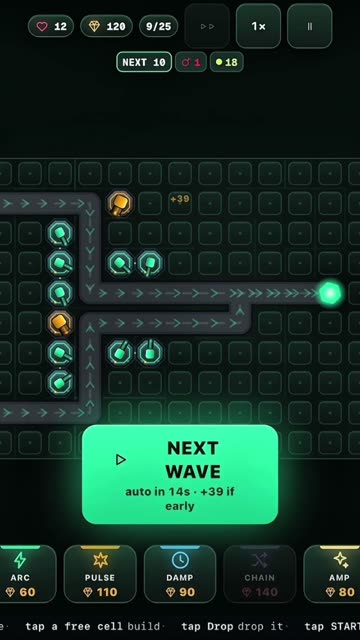
Circuit Defense is the closest thing here to a classic tower defense. Every board feeds enemies down two separate traces that end at the same core, and each wave is split between them, so no single tower holds the map. You either guard the junction where the traces meet, which is cheap but lets enemies get close, or answer each lane on its own, which costs twice as much.
The twist is adjacency. Nodes placed next to each other fuse into synergies: a Damp node beside a Chain node becomes Superconduct, and an Amp boosts whatever sits next to it, so a weaker node in the right spot often beats a stronger one on its own. Each node can target the First, Last, Strongest or Closest enemy. Armoured enemies shrug off weak fast guns, Phasers cannot be targeted by normal means, and Flyers ignore the lanes and head straight for the core. Every board is 25 waves with a Kernel boss every tenth wave. The first three boards are Mainboard, Crossbar and Spiral Core; after that the boards keep coming as mirrored versions with tougher enemies, and an endless mode opens once you secure your first board.
Which one to start with
Pick Castle Barrage if you want to knock a castle down by hand: it has the aiming, the bosses, the castle workshop and a live duel. Pick Lonewatch if you want a keep of your own that grows wall by wall while you decide what to buy. If the planning is the part you like, Thornwall makes you build the enemy’s road, and Circuit Defense makes you think about which tower stands next to which.
All five are free, run in a browser tab on a phone or a computer, and save your progress in the browser on that device, so the castle you built is still there next time.