Water sort is one of those puzzles you understand in ten seconds and keep playing for an hour. Tubes hold stacked layers of colored liquid, and you pour until every tube holds a single color. This page is for anyone who searched for a water sort puzzle, a color sort game or a ball sort puzzle and wants to play one right now in a browser tab, with no download.
We are going to be strict about one thing. Only the first three games below are true pour-to-sort puzzles, where you move a color from one tube to another. The last three are sorting games of a different kind: one flings colors out of the tubes, one ships blocks into crates, one has you build a machine. They are good, but if you want the classic, skip to the first two. All six are our own games, not the official Water Sort Puzzle or Ball Sort Puzzle apps, and the order is our own judgment.
What the classic rule is, and why it works
In a water sort puzzle you can pour a color only onto the same color, or into a completely empty tube. That is the whole rule set, and it creates the puzzle on its own. The color you need to free is usually buried under something with nowhere to go, so the work is finding the order of pours that unblocks it.
Empty tubes are the resource. Spend one carelessly and the level is lost; borrow one and give it back, and the level opens up. Almost every tip in this post comes back to that.
1. Pour & Reveal: the closest to the classic
This is a straight water sort puzzle. Tap a tube, tap another, and the whole run of one color on top moves as far as the second tube has room. Same color or an empty tube only.
What is ours is the reward. Every level hides its own picture, and each tube you finish colors in part of it. There are 40 levels, each a fixed puzzle, so level 12 is the same for everyone and every level has been checked to have a solution. The first two use three colors in six tubes. By the end you sort eight colors across ten tubes. Tubes hold four layers up to level 20 and five from level 21. Each color also carries its own texture, such as stripes, dots, waves or checks, so two similar shades never get confused.
There is no timer. Every level has a known shortest route, and your finished picture gets a frame to match: gold for the shortest route, silver for within about a quarter more pours, bronze for any other finish. Your gallery keeps every picture in the frame you earned. If a run of pours leaves a board that cannot be finished, the game says so at once and tells you how many pours to undo.
The honest difference: classic apps are mostly endless level counters. This one is 40 levels, with a picture at the end of each. Tip: with two undos and one hint per level, keep the hint for the first time you are truly stuck. Following it always finishes the level.
2. Fuse Sort: water sort with a lit fuse
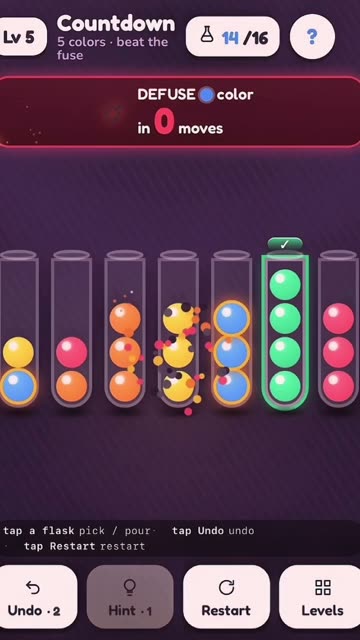
The pouring is identical, with one change. One color in every level wears a striped fuse cord with a spark, and that color has to be completely sorted before the move countdown reaches zero. Every pour ticks it down, whichever tube you touch.
That one rule rewires the puzzle. In an untimed sorter, patience wins. Here, patience can lose, because the fused color may be buried in four different tubes and you have to dig straight for it and accept a messy board everywhere else. Players lose more often to a fuse that ran out while they were tidying than to a position that could not be won.
The number next to your move count is par, and it is not an estimate. It is the shortest route that exists for that board, worked out in advance, so finishing on par means you found the best line. Levels climb from three colors with two spare tubes to ten colors across twelve tubes, and they keep coming after the last hand-made board, each one dealt with a fuse one pour shorter. On a keyboard you can play without a mouse: arrow keys move between tubes, Enter or Space picks up and pours.
The honest difference: it is not a relaxing sorter. If Pour & Reveal feels too gentle, this is the same puzzle with something at stake. Tip: when a level opens, find the fused color first and count how many pours it needs against the countdown before you touch anything.
3. Pour Merge: water sort meets 2048
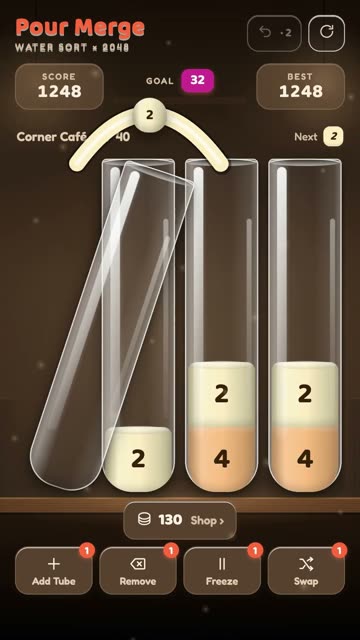
Here the tubes hold numbered tiles instead of colors. You pour as you would in a water sort puzzle, onto a matching tile or into an empty tube, and pouring a value onto the same value merges the two into one tile of double the value. Two fours make an eight.
It is still a pour-between-tubes game, but the goal is different. You are not sorting colors into separate tubes, you are building a number. Each level sets a goal tile, and a new tile drops in after every pour, so a level is lost when no legal pour is left. The goal climbs from 16 to 32, 64, 128 and finally 256 over four places: a warm corner café, a greenhouse, a glass lab and a neon night bar. The shelf grows from four tubes to six, and the levels keep coming after the night bar.
The honest difference: a pour here should either merge something or set up a merge. Pouring only to tidy up brings the next drop closer to jamming the shelf. Tip: look for chains before the first pour, a merge that creates a tile which can merge again, and again. We cover its cousins in our guide to merge games online.
4. Spin: color sort with tubes and no pouring
This is where the list changes kind. Spin keeps the tubes and the colored balls, but you never move a ball from one tube to another. Instead you tap a color button, and that color is flung out of every tube where it currently sits on top. A whole run of the same color goes at once, and the number on each button shows how many tubes it will hit right now.
So it plays like a sequencing puzzle. Removing red exposes whatever was under red in every tube at the same moment, which might hand you three new blue tops or bury the yellow you were setting up. Every level has a par, the shortest route the board allows. Clear it on par for three stars, one over for two, anything else inside the limit for one. The three stars above the board are live and drop the moment a tap makes par impossible.
Boards go from two tubes and two colors to five tubes and five colors. From level 41 some balls are frosted: the first fling of their color only cracks the ice and the next one sends the ball out. Each color also has its own symbol, a triangle, square, circle, diamond or plus.
The honest difference: it is not a water sort puzzle, because there is no pouring. It is the color sort idea reduced to one tap, with a hint bulb that lights the next color on the shortest route (the first hint on each level is free). Tip: crack frosted balls with a fling you were going to make anyway, and the ice costs nothing.
5. ArrowSort 3D: sorting by shipping crates
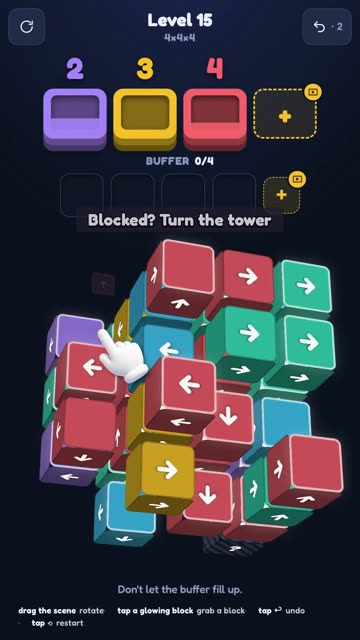
A tower of blocks turns in 3D. Blocks marked with an arrow can slide out in that direction, but only when nothing sits in the way, and glowing ones are the ones you can grab now. Tap one and it goes to a crate of its color, and a crate ships once it is full. Grabbed blocks wait in a limited buffer, and a buffer full of singles from five different orders is a dead position.
It is a sorting game in the sense that every block has to reach a matching crate, but nothing is poured and there are no tubes. Levels start with a stack of twelve blocks and grow to 4 by 4 by 4 cubes with as many as 63. Early levels keep three crates open with five buffer slots, later ones only two crates and three slots. Dark question blocks hide their color until their path is clear, and ice blocks stay frozen until a set number of other blocks have gone into crates.
The honest difference: it is closer to a tap-the-arrow puzzle than to water sort. Tip: finish crates instead of starting new ones, and open an extra slot with the + button before you are desperate.
6. Sorter: Build the Line: sort with a machine you build
The furthest from water sort, and the most original. You place ramps and color splitters on a grid, press Run, and watch a flood of balls pour through your machine into bins. You make every decision before the balls move, and then you only watch.
You are not guessing. While you build, a thin colored line traces the path each color would take right now, and every bin shows a tick or a cross. When all the bins show a tick, a run sorts correctly. Each level gives you a fixed kit of pieces with the count shown in the palette, and the puzzle is making that exact kit do the job. The first level is a 3 by 4 grid with two colors and one splitter, and the hand-made climb ends on 7 by 8 grids with four colors and walls in the way.
The honest difference: this is a routing puzzle, not a pouring one. Tip: tap a placed piece to flip its direction. A machine where three colors land right and the fourth trickles into the wrong bin is usually one flipped piece away.
How they compare
| Game | Pour between tubes? | Timer or limit | What you sort | Best for |
|---|---|---|---|---|
| Pour & Reveal | Yes | None | 3 to 8 colors, 40 levels | The classic, relaxed |
| Fuse Sort | Yes | Move countdown on one color | 3 to 10 colors | The classic with pressure |
| Pour Merge | Yes, and tiles merge | Lose when no pour is left | Numbers up to 256 | Water sort plus 2048 |
| Spin | No, tap a color to fling it | Par plus 2 or 3 moves | 2 to 5 colors | One-tap thinking |
| ArrowSort 3D | No, blocks go to crates | Limited buffer | Blocks by color | Rotating 3D puzzles |
| Sorter: Build the Line | No, you build a machine | None | 2 to 4 colors | Planning, then watching |
Where to play them
All six are free, run in a browser on a phone or a computer and need no download. Pour & Reveal and Fuse Sort have a hint and undo, so they work well when you only have a few minutes. If you want something slow for the evening, the Just Relax collection has both pouring games.
If you came for the classic, start with Pour & Reveal and add Fuse Sort when you want pressure. If you already finished a few hundred tube puzzles elsewhere and want something that feels new, try Spin for the one-tap version or Sorter for the machine.