 ArcadeWhale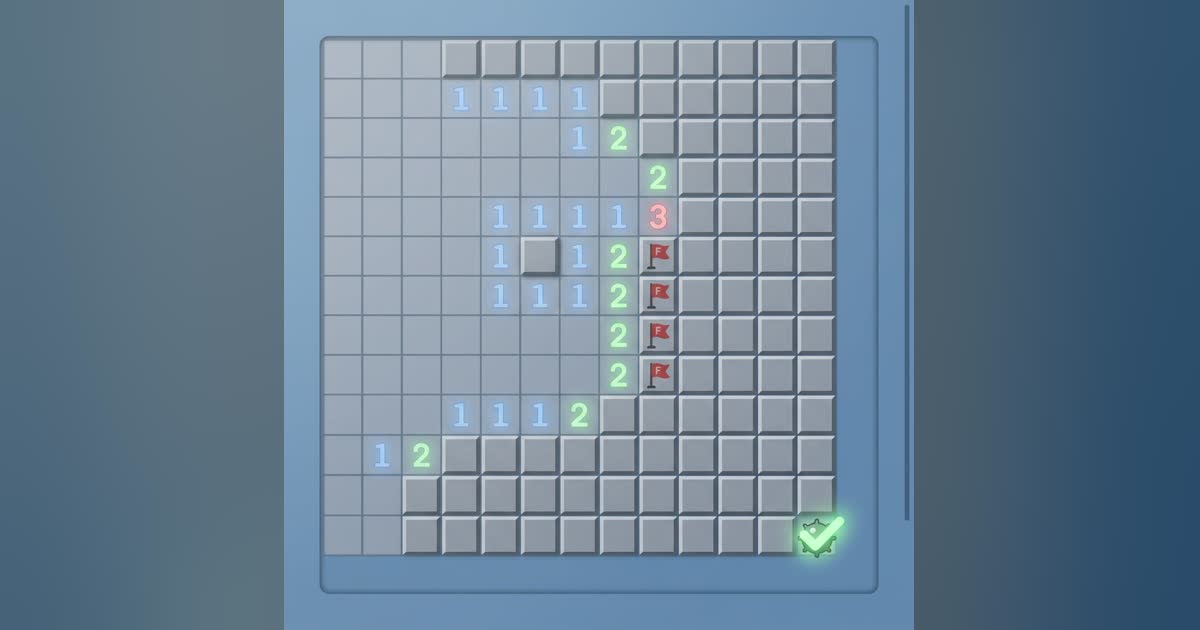
Minesweeper looks like a memory game and plays like a logic puzzle. Every opened cell shows a number: how many of its eight neighbours hide a mine. From those numbers you deduce where the mines are, flag them, and open everything else. The good news is that most of the reasoning comes down to about four patterns you can learn in ten minutes.
Start with subtraction
Before any pattern, one habit: a number minus its flags is what is left to find. A 3 with two flags touching it is really a 1. A 2 with two flags touching it is a 0, and every other neighbour of that cell is safe — open them all.
That last case is where chording comes in. When a number is fully satisfied by flags, clicking the number itself opens all its remaining neighbours in one go. On a phone it is a tap on the number. Once you trust your flags, chording is how a board that took four minutes starts taking ninety seconds.
Pattern 1 — the 1-1 on an edge
Two 1s side by side along a wall or along the edge of an opened area, with three covered cells beyond them, look like this (mines hidden below the row of numbers):
? ? ?
1 1 |     ← the | is a wall or an already-opened region
The left 1 touches the first two covered cells. The right 1 touches the second and third. The right 1 needs exactly one mine among its two cells — but the left 1 also needs exactly one among its two. Both share the middle cell. If the mine were in the first cell, the right 1 would have nothing. If it were in the third cell, the left 1 would have nothing. So the mine is in the middle cell and the outer cells are safe.
Corollary that comes up constantly: a 1 whose only unopened neighbour is a single cell — that cell is a mine, no reasoning required.
Pattern 2 — the 1-2-1
? ? ?
1 2 1
The 2 needs two mines among the three cells above it. The left 1 touches the first two of those cells and needs one; the right 1 touches the last two and also needs one. The only arrangement that satisfies all three numbers is mines in the first and third cells, and the middle cell safe. This is the pattern that unlocks the most boards, and once you have seen it a few times you will spot it across the grid at a glance.
Pattern 3 — the 1-2-2-1
? ? ? ?
1 2 2 1
Four numbers, four covered cells. Work from the outside in: the left 1 needs one mine among cells 1–2; the left 2 needs two among cells 1–3; the difference is that cell 3 must be a mine. Symmetrically cell 2 must be a mine. Then the 1s are each satisfied by one of those, so cells 1 and 4 are safe, and the mines sit in the middle pair.
Pattern 4 — the 1-2 with a shared wall
When a 1 and a 2 are adjacent and the 2 has one more covered neighbour than the 1, that extra cell is a mine. The logic is the same subtraction as before: whatever the 1 accounts for, the 2 needs one beyond it, and the only place it can go is the cell the 1 cannot see.
These four cover the majority of local deductions. What remains is global reasoning — counting how many mines are left against how many cells are unopened, which matters in the endgame — and the thing that gives Minesweeper its bad reputation.
The coin flip, and why it exists
In the original game and in most clones, mines are placed at random. Random placement regularly produces a position that no pattern and no amount of counting can resolve: two covered cells in a corner, one mine between them, and no number anywhere on the board that touches only one of them. You are asked to guess. On the Expert board, a clean twenty-minute game ends on a 50/50 more often than anyone likes to admit.
That is not a difficulty setting. It is the generator giving up.
What “no-guess” actually means
Our Minesweeper generates every board with a solver in the loop. Mines are placed, a logic solver tries to finish the board using only the deductions above, and if it gets stuck the generator moves a mine on the frontier and tries again — until the whole board can be reasoned out from the first click to the last flag. Only then does the board reach you.
The difference is measurable rather than a slogan. We generated sixty boards with plain random placement and ran the same solver over them: 29 of 60 needed at least one guess. With the solver in the loop the number is zero, and the game says so on the results card when you clear a board.
Three sizes carry three different jobs. Easy is 9×9 with 10 mines and teaches the patterns above. Medium is 16×16 with 40, where chording starts to pay. Hard is 30×16 with 99 mines, where the frontier gets long enough that you have to choose which end of it to work first. The first click is always safe and always opens a region, so the opening is never a coin flip either. There is also one Daily board that is the same for everyone, with a streak for coming back.
A little history
Minesweeper’s ancestors go back to mainframe games of the 1960s, but the version everyone knows was written by Robert Donner and Curt Johnson at Microsoft and shipped in the Windows Entertainment Pack in 1990, then bundled with Windows 3.1 in 1992. The unofficial purpose was to teach a generation of office workers to left-click and right-click with confidence. It stayed in every Windows release until Windows 8, which is why almost everyone over thirty has a specific memory of losing a game on the last cell.
Play it here
Classic rules, classic number colours, solver-checked boards, and a hint button that only ever opens a cell it can prove is safe. Start on Easy, learn the 1-2-1, and move up when the patterns start to feel obvious.
