 ArcadeWhale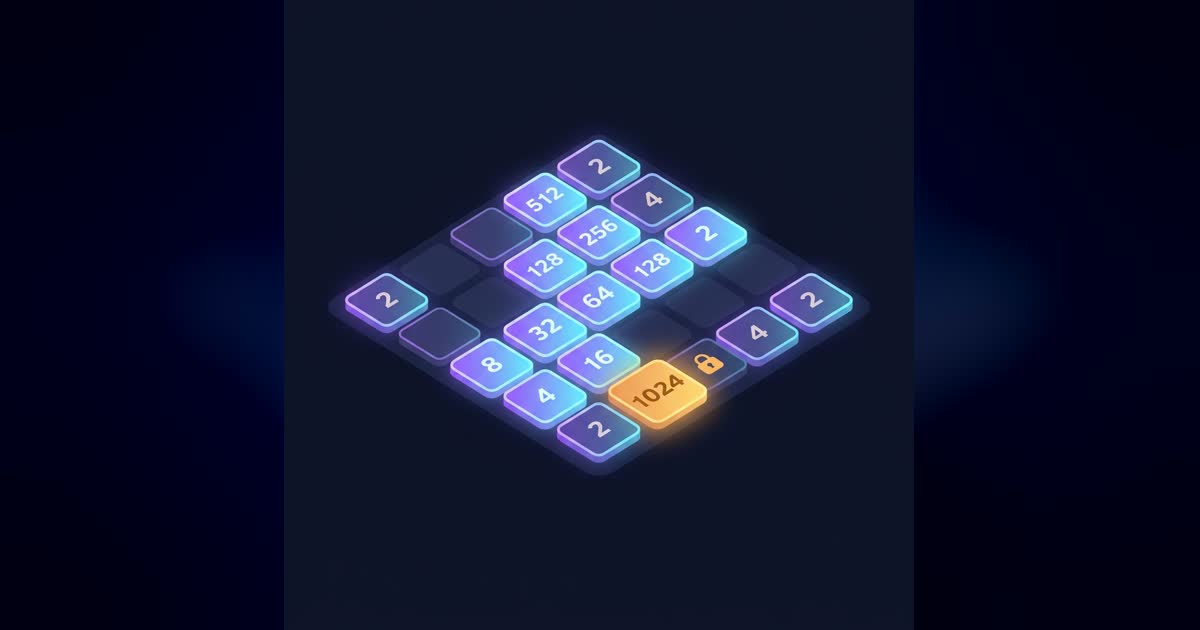
2048 has exactly one rule — slide, and equal tiles that touch become one — and it still manages to end most games in under three minutes. That is not because the game is hard to understand. It is because the good move and the satisfying move are often different, and the satisfying one is the one that loses.
This guide is the strategy that competent players actually use, written down. It is short because the strategy is short; the difficulty is holding to it.
The one idea: a corner and a chain
Choose a corner. Any corner — bottom-right is the usual choice — and decide that your largest tile lives there for the rest of the game. Everything else follows from that decision.
Next to the big tile, along the edge, you build a chain that runs down in value: 512, 256, 128, 64 in a row, say, with the 512 in the corner. When a 64 arrives next to the 64, it becomes 128, that merges into the 128 beside it to make 256, and the whole row collapses one step towards the corner. The chain is a conveyor belt that delivers merges to your big tile.
The reason this works is that a 4×4 board only has sixteen cells. A large tile sitting in the middle blocks four neighbours; the same tile in a corner blocks two. Every high tile you fail to park in a corner or against an edge is a cell you can no longer use, and the game ends when you run out of cells.
The three-direction rule
If your corner is bottom-right, your three directions are down, right and left. Up is forbidden. The moment you press up, tiles rise away from the bottom edge, a new tile spawns underneath your big one, and the corner is gone. You will spend the next twenty moves trying to get it back, and you usually will not.
Left is allowed but costs something: it slides your bottom row away from the right wall, and the gap that opens on the right can be filled by a random spawn. So the real priority order is:
- Down — always safe if it merges something.
- Right — keeps the row pinned to the wall.
- Left — only when down and right do nothing useful, and only when the bottom row is full so nothing can slide.
- Up — never. Not to grab one merge, not because the board “looks stuck”. If up is truly the only legal move, the game was already lost several moves ago.
Most losses trace back to a single up-swipe that looked harmless. Treat it as a button that is not there.
Keep the board empty, not the score high
Score is a side effect. The number that decides whether you are alive is empty cells. Every move spawns a tile, so a board with two free cells is two moves from a crisis and a board with eight free cells has a future regardless of what the score says.
That leads to a habit that feels wrong at first: merge small tiles immediately, even when a bigger merge is available somewhere else. A 2 next to a 2 is a free cell waiting to happen; leave it and the next spawn lands beside it and now you have three small tiles cluttering the row above your chain. Sweep the small stuff constantly, and the big merges arrive on their own.
Reading the spawn
New tiles are a 2 ninety percent of the time and a 4 the rest. They appear in a random empty cell — which means the more of the board you keep empty away from your corner, the less likely a spawn lands somewhere annoying. If the only free cell is the one next to your 1024, that is where the 2 will go.
This is also why you should keep the bottom row full at all times. A full row cannot receive a spawn, so nothing can wedge itself between your big tiles. The moment the bottom row has a gap, filling it becomes the priority, even at the cost of a merge elsewhere.
When the chain breaks
It will. A 4 spawns in exactly the wrong place, or you are forced left when the row was not full. The board now has your 512 in the corner and a 2 trapped between it and the 256 that was supposed to merge into it.
Do not panic-swipe. The way out is to build a second chain in the row above, running the opposite direction, and merge it down into the first one when the trapped tile has been cleared. It is slower and it costs you several moves of pure tidying, but it usually saves the game. What does not save the game is pressing up to “free” the tile — that just moves the problem into your corner.
Beyond 2048
Reaching 2048 needs the chain to hold for roughly 900 moves. Reaching 4096 doubles that, and by 8192 you are managing two full chains at once: the bottom row holding 4096-2048-1024-512 and the row above holding the next four values in reverse. The strategy does not change; the tolerance for error does. A single spawn in the wrong cell at that stage can cost you the game because there is no longer spare room to work around it.
The theoretical ceiling on a 4×4 board is a 131072 tile, and it needs the game to hand you a 4 at the precise moment the rest of the board is a perfect chain. Nobody plans for it. 8192 is a genuinely good result, and 16384 is the point where you can be pleased with yourself.
A short history
2048 was written in March 2014 by Gabriele Cirulli, a nineteen-year-old developer in Italy, over a single weekend, as a clone of a game called 1024 — which was itself inspired by Threes!, a paid iPhone puzzle released a month earlier. Cirulli put it on GitHub for free, it spread across the web within days, and within a month it had been played by millions of people. It remains one of the most-copied game designs of the decade, and the reason is that the rule fits in one sentence and the strategy fits in one guide.
Play it here
Our version keeps the classic 4×4 board, arrow keys or WASD on desktop, swipe on a phone, and saves your best score on your device. Open it, pick a corner, and forget the up key exists.
