Merge games are everywhere on phones, and most of them share one idea: two of the same thing become one better thing. What people mean by “merge game” is less clear, because the rule shows up in very different games. A cozy board where you build what a customer orders, a box of fruit that keeps filling up, a grid of numbers, a road of monsters you hold back with merged towers: all of them are merge games.
This page sorts our own free merge games by that type, so you can go straight to the kind you like. All of them run in a browser tab on a computer, a Chromebook or a phone, with no download and no account. None of them is the official version of any of the well-known games named here.
What a merge game is
The rule is simple: drag two identical items together and they turn into one item of the next level. Most merge games are “merge-two” games like this. A few, such as Merge Dragons, merge three at a time, but the idea is the same.
The rule has a cost built in. Each level is made from two of the level below, so the price doubles every step. A level 4 item is 8 starter items and 7 merges. A level 9 item is 256 starters and 255 merges. That doubling is the engine of the whole genre: the next level always looks close, and it is always twice as far as the last one.
What a game builds around that rule decides what kind of merge game it is. You can feel the board type, the most common one on phones, in the small board below.
Try it: make what the pet asks for
This is a tiny version of the board in Tailwag Merge, the first game below, using its toy chain. Tap the crate to get an item. Tap two identical items, or drag one onto the other, to merge them. When the item in the bubble is on the board, tap the pet to hand it over.
A merge board in miniature
Tap the crate in the corner to get a Yarn Scrap.
Item names, crate levels and drop odds are the ones Tailwag Merge uses today. A level 1 crate always drops a Yarn Scrap. A level 3 crate drops a Yarn Scrap 65% of the time, a Yarn Ball 28% and a Big Yarn Ball 7%, and a level 6 crate can drop a Knit Mouse outright. From level 4, a few taps drop something else instead: a Cloth Scrap from the bed chain, or paws. The real board is bigger, crates run empty and rest for a short while, and the chains go further than a Knit Bunny.
Merge the same few items for a while and the numbers in the counter start to tell the story of the genre. From a starter crate a Knit Mouse is always 8 taps and 7 merges, and a Knit Bunny is 16 taps and 15 merges. Raise the crate level and the same toy gets cheaper, because a better crate sometimes skips a step for you.
We measured how much cheaper by rolling the game’s own drop table 200,000 times for each crate level and counting the taps until there was enough yarn on the board for one Knit Mouse, the taps that dropped something else included:
| Crate level | 1 | 2 | 3 | 4 | 5 | 6 |
|---|---|---|---|---|---|---|
| Taps for a Knit Mouse, on average | 8.0 | 6.8 | 5.7 | 5.1 | 4.4 | 3.9 |
A crate at level 6 roughly halves the work. That is the quiet trick behind every board merge game: you never stop paying the doubling, but the tools you merge on the side make each step a little cheaper, so the climb keeps moving.
The four kinds of merge game
| Kind | What you do | Well-known examples | Ours |
|---|---|---|---|
| Board merge with orders | Tap crates, merge items up chains, fill orders, fix up rooms | Merge Mansion, Travel Town, Gossip Harbor | Tailwag Merge |
| Drop and merge | Drop pieces into a box, twins merge when they touch | Suika Game | Pastry Pile |
| Number merge | Slide or pour numbers so equal ones add up | 2048 | 2048, Pour Merge |
| Merge and fight | Merge units or towers to make them stronger, then defend | Merge defense ads, merge tower defense | Pumpkin Patrol, Gatefire |
Board merge with orders
This is the type most people mean by “merge game” today. You have a board of cells, a few crates that drop starter items, and a list of things someone wants. Merging is how you make those things, and what you earn from filling orders pays for something bigger: a mansion to restore in Merge Mansion, a town to rebuild in Travel Town.
1. Tailwag Merge: a merge board in an animal shelter
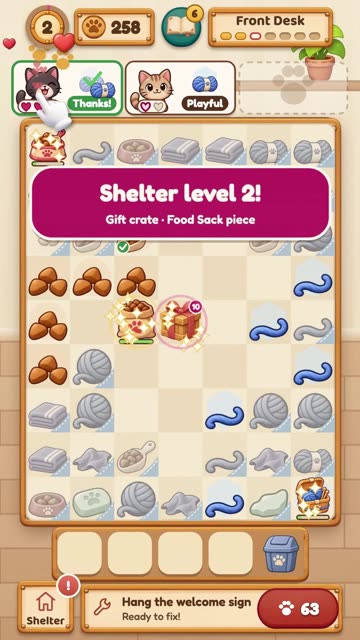
Tailwag Merge is our own board merge game, set in a small animal shelter that needs work. Pets come in and wait at the front counter beside the board, each with a speech bubble that shows what it needs: a bowl of kibble, a yarn toy, a cushion. You make it. Tap a supply crate and it drops a starter item, drag two identical items together and they merge into the next one, and tap the pet to hand it over once the bubble’s item is on the board. Some pets want one gift and some want two or three, and when the last one arrives a family adopts the pet. A photo card shows who went home and the pet gets a page in your adoption album.
The board is nine cells by seven, and today there are six item chains, each one thing growing step by step so you can guess what comes next: kibble fills a bowl, a scrap of yarn gets knitted into bigger and bigger toys, a scrap of cloth becomes a bed, soap ends up a spa, cotton ends up a vet cart and a seed ends up a basket of vegetables. Dogs and cats eat from the food chain, and bunnies, birds, hamsters and tortoises eat what you grow.
The pieces you know from the big phone games are all there. Donation boxes on the board show what is inside and open only when you drop the twin of that item on them. Two matching crates merge into a bigger crate that drops better items, which is what the demo above measures. Adoptions pay paws, and paws pay for repairs: a new rug, a window, string lights, until the room is done and the next one opens with a new supply crate and new pets: Kennel Row, the Garden Room, the Bath Corner, the Clinic, the Hamster Den, the Big Yard, and more after that. Some pets need care before they take a gift. A napping one wants a bed, a muddy one a wash, a sick one the vet bag. When the board gets crowded there are storage slots for items you need later, and a bin that pays a few paws for the rest.
What is different from Merge Mansion or Travel Town: there is no energy bar. A crate that runs empty rests for a short while and comes back full on its own, and nothing is sold to skip the wait. There is no mystery story either; the story is the pets, one adoption at a time. And it opens in a browser tab, with your board, paws, rooms and album saved in that browser. It is our own game and has no connection to either of those games.
Drop and merge
The drop-and-merge type was made famous by Suika Game, the watermelon game: pieces fall into a box, two identical pieces that touch merge into the next size, and the run ends when the pile stays above the line. There is no order list and no crate, only gravity and the next piece.
2. Pastry Pile: Suika-style merging with pastries
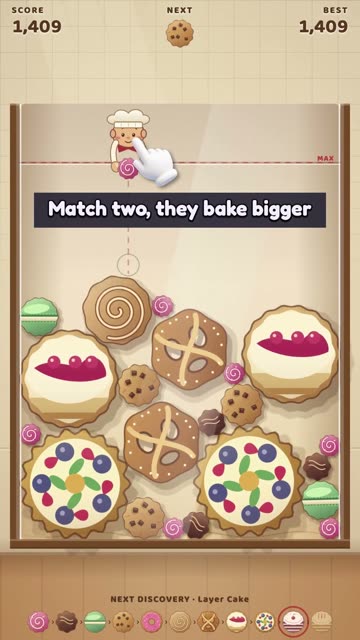
Pastry Pile is our own drop-and-merge game. You aim a pastry above a glass tray and let go, and two of the same kind merge into the next size up, through eleven sizes from a tiny Sprinkle to a Grand Gateau. Only the smallest sizes ever drop, so everything big has to be built, and the Next bubble shows the piece after the one in your hand. Pastries roll and wedge into gaps, so a chain of merges can tidy the tray or wreck it. It is one long run with a best score to beat.
The difference from board merge games is that space is the whole puzzle. Nobody asks for anything; the tray just keeps filling. We have a whole page on this type, with a demo of how big each pastry gets: games like Suika.
Number merge
Number merge games drop the pictures and keep the arithmetic. Two equal numbers become their sum, so every merge is a visible doubling.
3. 2048: the classic number merge
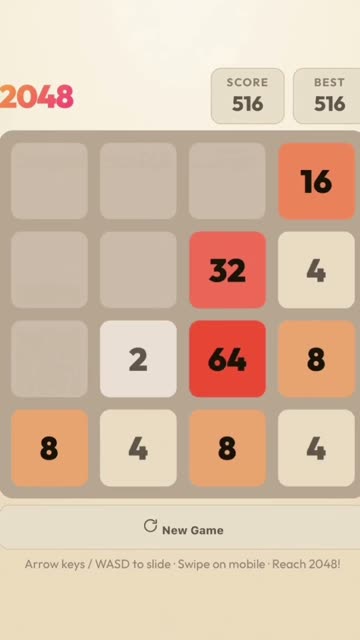
2048 is the game that made merging famous on the web. Swipe or press an arrow key and every tile on the four by four grid slides that way. Two tiles with the same number that run into each other merge into their sum, and a new tile appears after every move. Reach the 2048 tile, then keep going for a bigger one on the same board.
It is the purest merge game on this page: no physics, no orders, no luck beyond where the next tile lands. Every mistake is yours, and so is every good run. Our 2048 strategy guide covers the corner method most good runs are built on.
4. Pour Merge: number merges in tubes
Pour Merge puts 2048 inside a water sort puzzle. Numbered tiles sit in tubes, and pouring a tile onto the same number merges the two into one tile of double the value. After every pour a new tile drops into one of the tubes, and a level is lost when no legal pour is left, so every pour should either merge something or set up a merge.
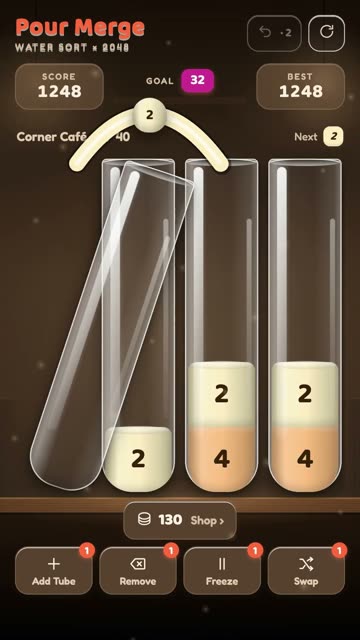
In that 35-second clip a 4 poured onto a stacked tube merges all the way up to 128. Where 2048 is one long run, Pour Merge has levels with a goal tile each, across four worlds, and the levels keep coming.
Merge and fight
The last type uses merging as a way to get stronger. You merge units or towers, and what you built has to hold off something coming at you. Phone ads for “merge defense” games are mostly this type.
5. Pumpkin Patrol: merge defense on Halloween night
In Pumpkin Patrol your towers are jack-o’-lanterns on a lawn beside a road, and their circling bats bop the skeletons, ghosts and mummies walking toward a cauldron of candy. Drop a lantern on another of the same family and level and they merge into a stronger one, with more bats or a wider circle at each level. New lanterns grow out of giant pumpkins beside the road, and the lawn fills up the way a merge board does.
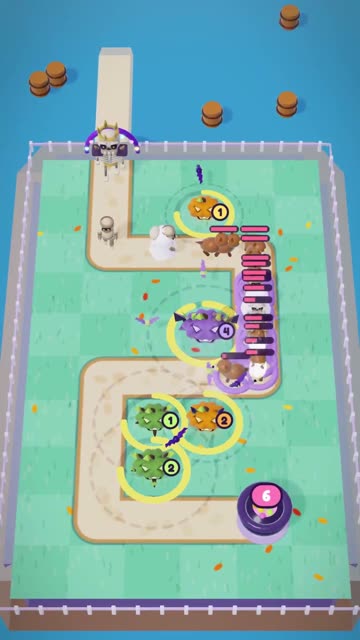
In this 20-second clip a Bat and a Briar of the same level merge into a Thornwing, which then has to stop a Bone Giant before the last bend. That is the twist of merge defense: fewer, stronger lanterns hit harder but leave gaps in the road, so every merge is a choice between power and coverage. It has a Halloween look and plays well past the season.
6. Gatefire: merging that happens on its own
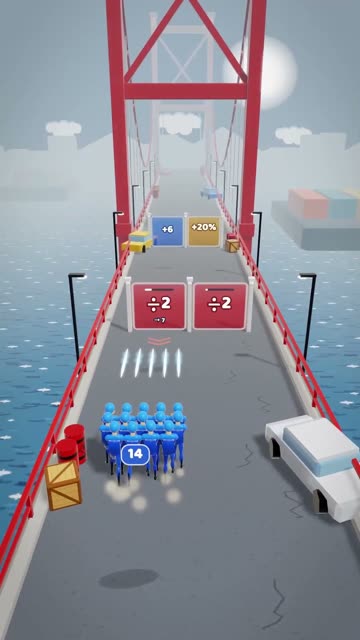
Gatefire is a gate runner first. You steer a squad across a zombie bridge and shoot gates to grow it, and the merge is a side effect: ten soldiers of the same rank merge into one stronger soldier, with a rank marker on the unit, without losing any of the squad’s power. You never drag anything. If you like watching a merge chain go off more than planning one, it scratches the same itch at a much faster pace.
How they compare
| Game | What you merge | Where | What keeps you going |
|---|---|---|---|
| Tailwag Merge | Supplies in six chains, and the crates themselves | A nine by seven board | Pets to adopt, rooms to repair |
| Pastry Pile | Pastries, eleven sizes | One tray, with physics | A best score and the next size |
| 2048 | Numbered tiles | A four by four grid | The next goal tile |
| Pour Merge | Numbered tiles | Tubes | A goal tile on every level |
| Pumpkin Patrol | Jack-o’-lanterns | A lawn beside a road | Nights to survive, streets to clear |
| Gatefire | Soldiers, on their own | A bridge full of zombies | Stages, weapons and bosses |
Tips for board merge games
- Read the order before you merge. Build the exact level a pet or customer asks for. Merging everything as high as it goes fills the board with things nobody wants yet.
- Merge to make room. Every merge frees a cell. When the board is tight, merging two low items you will need anyway is better than tapping the crate again.
- Merge your generators. In games where crates or generators merge, a better crate pays for itself, as the table above shows. Keep a spare crate instead of selling it.
- Pick the box you want. When a box opens only for its twin, look at what is inside each one and build the twin of the best one first.
- Park, do not sell, what you will need. A high-level item took many merges. Storage is cheap, and rebuilding it is not.
More games built on merging are on the merge tag and the Sort & Merge page. If you like the space-management side of these games, our list of games like Block Blast has more puzzles where every move is about making room.