 ArcadeWhale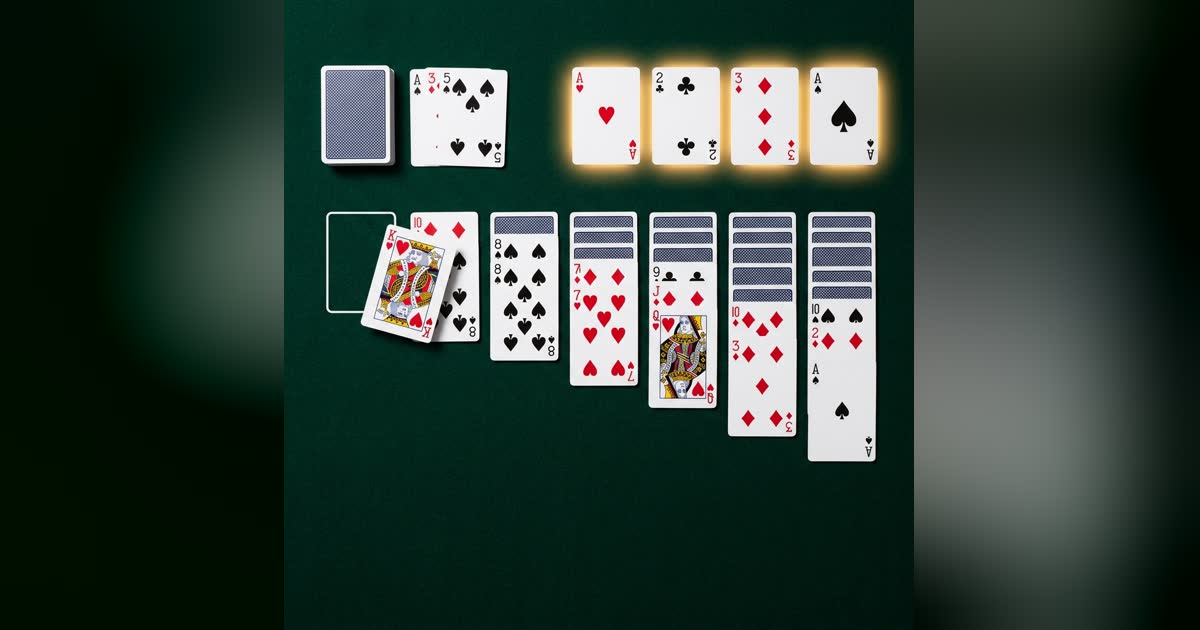
Klondike is the Solitaire. There are hundreds of solitaire games, but when someone says the word they mean this one: seven columns, four foundations, one deck, and a quiet half hour spent turning chaos into four neat piles. Here are the rules in full, the handful of decisions that decide most deals, and an honest answer to the question everyone asks — how many games can actually be won.
The rules
Setup. Seven tableau columns. The first has one card, the second two, up to seven in the last; only the top card of each column is face up. The remaining 24 cards form the stock. Four empty foundation piles sit at the top.
Goal. Move all 52 cards to the foundations, each built up by suit from Ace to King.
Tableau moves. Cards in the tableau are built down in alternating colours: a red 7 goes on a black 8, a black 6 on that red 7. You can move a single card or a whole face-up run, as long as the bottom card of the run fits the card you are placing it on. When you move the last face-up card off a column, the face-down card beneath it turns over.
Empty columns. Only a King, or a run headed by a King, may be moved into an empty column.
The stock. Turn cards from the stock onto the waste pile — one at a time in draw-one, three at a time in draw-three, where only the top card is playable. When the stock is empty, the waste turns back over and becomes the stock again.
Foundations. An Ace can go to an empty foundation at any time; then the 2 of that suit, the 3, and so on. Cards can be moved from the foundation back to the tableau if you need them, though most players never do.
That is all of it. The game is simple to state and surprisingly deep to play well.
The four decisions that matter
1. Which face-down cards to chase. Every hidden card is information you do not have. Prefer moves that turn over a face-down card to moves that merely rearrange face-up ones, and prefer the longer columns — the ones with more hidden cards — because each reveal there unlocks more.
2. What goes into an empty column. Clearing a column is worth a lot; filling it carelessly throws that value away. A column is a parking space for a King and everything that will build under it. If you have two Kings available, take the one whose Queen you can see. If you have none, leaving the column empty for a few moves is often better than moving a King just because you can.
3. When to send cards up. Aces and twos go up immediately — nothing can ever be built on an Ace, and a 2 only ever holds an Ace. From the 3 upward, pause. A black 5 in the tableau is a place to put a red 4; the same 5 on the foundation is not. The rule of thumb: send a card up only when nothing in the tableau or the waste could still need it, or when you need the space.
4. The order you play the stock. In draw-three, the card you can play changes the sequence of everything after it. Before playing a stock card, ask whether taking it shifts the next pass so that a card you need becomes reachable — or unreachable. Skilled draw-three players often skip a playable card on purpose.
What the maths says about winning
Not every deal is winnable, and that is genuinely part of the game rather than a flaw.
For Klondike with draw-one and unlimited passes, researchers who ran computer solvers over large samples of random deals found that roughly 80–90% of deals are winnable — but only with perfect information, meaning the solver could see every face-down card. Play “thoughtfully” with hidden cards, making the best decision available from what is visible, and the estimate drops; draw-three with a limited number of passes drops it further, into the range where a good human might win one game in three or four.
What that means in practice: a losing streak is usually the deck, not you, and a win rate around 30–40% on draw-three is a strong result. If you want a higher win rate, play draw-one; if you want the harder puzzle, play draw-three and count your passes.
The bit everyone skips
Klondike has one famous piece of drudgery. Once the last face-down card has been turned over, the game is mathematically already won: every column is a clean descending run, so nothing can go wrong. And yet the classic version still makes you click every remaining card up to the foundations, one at a time, forty-odd clicks to confirm a result you already know.
Our version watches for exactly that moment. When the outcome is settled — every hidden card exposed — a gold Finish button appears and plays the rest out for you, card by card, so you watch the win instead of typing it in. It never appears earlier, so it never takes a decision away from you.
Why Solitaire is on every computer
Klondike Solitaire was written for Windows 3.0 in 1990 by Wes Cherry, an intern at Microsoft, and shipped with every version of Windows for the next two decades. The official purpose was to teach new users to drag and drop with a mouse; the unofficial result was that a card game became one of the most-played pieces of software in history. Cherry was never paid for it.
Play it here
Drag cards to build columns, double-click to send a card to a foundation if it has somewhere to go, click the stock to deal, and use Undo when a move turns out to be wrong. A fresh deal is one click away, and the deal you left is still there when you come back.
