Arcade Whale OriginalMade in-house, free to play
Last Gun
16+ AI-assisted artwork
Contains scary or violent scenes. Recommended for ages 16 and up.
- Developer
- Arcade Whale
- Genre
- Action
- Rating
- Plays
- Released
- Updated
- Platforms
- Browser (desktop, mobile, tablet)
- Orientation
- Landscape (turn your phone sideways)
- Players
- Online multiplayer
How to play
Desktop W A S D move · Shift sprint · Space jump · C crouch · R reload · G grenade · mouse looks, click fire, right-click aim
Touch Stick moves, drag looks, FIRE shoots
About Last Gun
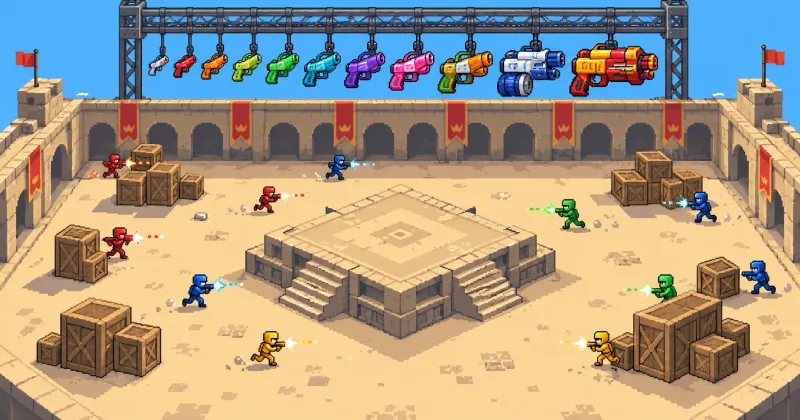
Last Gun is a free-roaming first-person gun game. You spawn into an open arena and you move wherever you like: W A S D to move, Shift to sprint, Space to jump onto a crate or up onto the raised centre platform, C to crouch behind cover, the mouse to look. The left button fires and the right button aims — aiming zooms in, tightens your spread and is the only way to use the Sniper scope. Every shot kicks the view up, so on the automatics you pull down to stay on target, and the crosshair opens while you move or jump to show where the next round can land. On phones drag empty game space to look and use the separate FIRE pad to shoot; optional Auto shoots only on a visible target. Three military maps share the rotation. Before a Practice match, in either mode, you can pick one from the map tiles on the menu or leave it on Random, while an online table is dealt a map that fits its size: Outpost is a sun-bleached desert base ringed by blast walls and razor wire, with a wide concrete platform and ammo crates stacked in every corner, Harbor is the same size but its platform is narrow and its crane legs sit back against the container walls, which opens long lanes down the sides, and Old Town is a stone plaza half again as wide, with sandbag lines, twice the cover and sixteen spawn points, for the big tables. There is no post to stand on and nothing pinning you down. The whole floor is yours, and so is everyone else’s.
Team Deathmatch is the main mode on the menu. Two squads of five spawn on opposite sides of the map, you pick one loadout gun from the rack before you deploy — Rifle, SMG, Shotgun, Sniper, DMR, LMG or Burst Rifle — and you keep it all match. Guns you have not unlocked yet stay on the rack with a padlock and the level that opens them, and the panel beside it shows each gun’s damage, fire rate, range and control. Every kill scores one for your squad, the first squad to 75 kills wins, and if the six-minute clock runs out the squad ahead takes it. Friendly fire is off and your rounds pass through teammates, a blue chevron floats over every teammate so you never have to guess before you fire, and the round minimap in the corner shows your squad as blue arrows and flashes a red dot wherever an enemy has just fired. The score and the clock sit at the top of the screen, the kill feed in the corner names who dropped whom and with what, and a fresh life always spawns you near your squad and away from the enemy. A win adds a five-chip bonus on top of one chip per kill. Find a match plays it online: you sit at a ten-seat table where even seats make one squad and odd seats the other, people play where people sit, the empty seats fill with fighters from the house so the match starts at once, and a friend in the queue can end up on your squad or across from it. Practice plays the same match offline, on the map you picked.
Every match also feeds a career. Kills, headshots, finishing a match and winning it earn experience, and each new player level pays ten chips and opens more of the loadout: Rifle and SMG from the start, then the Shotgun at level 2, the DMR at 3, the LMG at 4, the Burst Rifle at 6 and the Sniper at 8, which takes most players a little over half an hour. Each gun also levels on its own from the kills you make with it, in either mode. Level 2 adds an extended magazine, level 3 a grip for a tighter spread, level 4 a faster reload, and level 5 unlocks the Onyx finish, the one finish chips cannot buy. Level 5 also opens that gun’s mastery: three challenges — a long run of kills, a set of headshot kills and a handful of five-kill streaks, all with that gun — and each one pays a finish that only that gun can wear: Ember, Arctic and Jade. Clear all three and the gun earns Prism, a colour that slowly cycles through the spectrum, and Prism on three different guns unlocks Apex, a shimmering gold for every gun. Career on the menu shows each gun’s challenges and lets you pick which earned finish it wears. Attachments only ride along in Team Deathmatch, where you chose the gun, so Gun Game stays the same rack for everyone. Three daily challenges, drawn fresh every day from a list of ten, pay extra experience and chips, and Career and Daily on the menu show where every gun and every challenge stands. In Team Deathmatch you also carry one frag grenade each life, thrown with G or the NADE pad, which bursts where it lands and does not hurt your squad.
Gun Game is the second mode, and the rack is the rule that makes it a gun game. Twelve weapons hang on the gantry overhead, everybody starts on the first one, and you never choose a weapon: every kill you score moves you one rung up the ladder and puts the next weapon in your hands. The match is won by the first fighter to get a kill with the last gun — the .50 Cal, a single-shot rifle you have to chamber before it fires, whose round goes through everything it touches. Being one rung from the top is not the same as winning; you still have to land that final kill while everyone in the arena knows exactly where you are.
Because the rack chooses for you, the twelve guns are twelve different problems rather than twelve damage numbers. The Pistol is one press, one shot. The SMG is the fastest gun on the rack but its spray opens the longer you hold. The Shotgun throws nine pellets and is dead weight past mid-range, so it pushes you to close in. The Sniper wants you still and far back. The DMR is semi-automatic and its round goes through two bodies if you line them up, the LMG carries an 80-round belt but takes three seconds to reload, the Launcher lobs a grenade that has to be aimed above the target, the Rifle climbs as you hold the trigger so you have to pull it down, the Magnum takes six heavy rounds and kills with two to the body, the Burst Rifle fires three rounds per press, and the Rocket explodes on whatever you aim at. Headshots do double damage on every one of them, so the arena rewards aim as much as position.
The bar floating over each fighter’s head is their rung, so you can read the whole match at a glance and see who is one kill from ending it. Dying can cost you a rung, but only a cold death does: if you go down without having scored a kill since your last spawn, you drop one — trade first and you keep your place. It only applies from the fourth gun upward, so the opening minutes are a free learning band you cannot be knocked out of. You bank two chips for every kill, and they buy gun finishes from Chips · Shop on the main menu: five colours for the gun in your hands, from Olive at 30 chips to Gold at 180. A finish changes how your gun looks and nothing else — every gun hits exactly the same. Tougher rivals come from time served, and what grows is the pressure rather than the marksmanship: your first three matches are against Rookie rivals, who come at you one at a time, take a beat before they open fire and let the trigger go between bursts; three finished matches bring in Recruits, who can double up on you; six unlock Veterans, who barely hesitate; ten bring in the Warden — a rival that goes after whoever is leading the rack instead of whoever is closest, so being in front finally costs something — twelve add the Lurker, a rival that crouches behind a crate or pillar you cannot see past and only rises to fire when you come close, turn your back on it or shoot it, so checking cover and watching your back finally matter — and fourteen unlock Elite rivals, who all turn on you the moment they see you and never let up. The Warden wears a warm cone over its rung and the Lurker a purple eye, and the eye still shows over low cover while it waits. The menu names the tier you are about to face before you go in.
Gun Game is built to be played against people. Pick a table size — 1v1, 1v3, eight or sixteen — and Find a match puts you into a Last Gun match with no code to type and no invite to send; a short lobby lists who is in and counts the start down, and a match never begins on an empty floor. No two rivals fight alike: the rusher comes straight at your face, the holder sits back and keeps a lane, the flanker circles for your back, and the roofer takes the centre platform and refuses to give it up. Practice plays the same table offline, and every New match on the end card looks for an online table again. Your very first visit skips the menu: you drop straight into a short Team Deathmatch — first squad to 30 kills, or two minutes on the clock — facing one rival who walks in and holds fire until a few seconds after your first shot. It pays a one-off experience bonus on top of the usual, and the menu is there from your next visit.
Frequently asked questions
How do you play Last Gun?
Run the arena with W A S D and hold Shift to sprint, look with the mouse, press the left button to fire (hold it on the automatics) and the right button to aim. Space jumps, C crouches, R reloads early, and in Team Deathmatch G throws your grenade. Pick a mode on the menu. In Team Deathmatch you choose one loadout gun, fight in a squad of five, and the first squad to 75 kills wins. In Gun Game every kill promotes you one rung up a twelve-gun rack and hands you the next weapon; the match ends when someone scores a kill with the last gun on it, the .50 Cal. You cannot fire while sprinting: let go of Shift and the gun comes up a moment later.
How does Team Deathmatch work?
Two squads of five, one loadout gun each. Every kill is a point for your squad; the first to 75 wins, and if the six-minute clock runs out the squad ahead wins, or it is a draw. Friendly fire is off. Teammates wear a blue chevron, the minimap shows them as blue arrows and marks an enemy with a red dot for a moment whenever it fires, and you respawn near your squad, away from the enemy. The end card shows both squads with kills and deaths. Find a match plays it online at a ten-seat table, with the empty seats filled from the house; Practice plays it offline on the map you pick.
Why can I not choose my weapon?
In Team Deathmatch you can: the loadout picker on the menu sets your gun for the match. In Gun Game you cannot. That is the gun game format, and it is the point. Everyone climbs the same ladder in the same order, so the question is never “which gun is best” but “how do I fight with this one”. A Shotgun wants you close and a Sniper wants you far, so the weapon effectively decides where you should be standing.
What happens when I die?
The camera pulls back behind your body the moment you go down and turns to the rival who shot you, the card names them, a bar counts the respawn out, and the view drops back to first person as you come back at one of the spawn points spaced around the edge of the arena, facing the middle. Whether you lose a rung depends on the life you just finished: go down without a single kill since you spawned and you drop one, but if you traded at least once you keep the gun you earned. The drop only applies from the fourth gun onwards — the first three are a free band, so a bad start costs you nothing but time.
Is it really multiplayer?
Yes, both modes. Press Find a match: there is no code to type and no invite to send, a short lobby counts the start down, and a match never begins on an empty floor. Team Deathmatch seats ten in two squads of five; Gun Game lets you pick a table size — 1v1, 1v3, eight or sixteen. Empty seats fill with fighters from the house. Practice plays either mode offline.
Does it work on a phone?
Yes, and it is built for it. The left stick walks, and pushing it all the way up sprints; drag empty game space to look, and use the separate FIRE pad to shoot, or the second FIRE button on the left so both thumbs can shoot. In Team Deathmatch the NADE pad throws your grenade. AIM, JUMP, CROUCH and RELOAD handle the other actions. Under Shooting, optional Auto fires only while a visible rival is under the crosshair and you hold a look drag. Lift and drag again for a larger turn; looking never fires in Button mode.
What are chips for?
Chips buy gun finishes. You earn two for every kill, and Chips · Shop on the main menu turns them into a colour for the gun in your hands: Olive, Desert, Cobalt, Crimson or Gold, from 30 to 180 chips. A finish is looks only — damage, recoil and the rack stay the same for everyone — and you can switch back to any finish you own for free. A sixth finish, Onyx, is not for sale: it unlocks when any of your guns reaches weapon level 5. Mastery finishes are not for sale either: each gun earns its own from its mastery challenges, and Prism on three guns unlocks Apex for all of them.
How do levels and attachments work?
You earn experience for every kill, more for a headshot, plus a bonus for finishing a match and a bigger one for winning it, and your very first match pays a one-off bonus on top. Player levels open the Team Deathmatch loadout one gun at a time, from the Shotgun at level 2 to the Sniper at level 8, and pay ten chips each. Every gun also has its own weapon level from the kills you make with it: an extended magazine at level 2, a grip at 3, a faster reload at 4 and the Onyx finish at 5. Level 5 also opens three mastery challenges for that gun — kills, headshot kills and five-kill streaks with it — each paying a finish only that gun wears; all three pay Prism, and Prism on three guns pays Apex. Attachments help without deciding a fight, and they only apply in Team Deathmatch. Three daily challenges, such as 25 kills or a five-kill streak, refresh every day and pay extra experience and chips.
How do I know who is winning?
In Team Deathmatch the two squad scores and the clock sit at the top of the screen, each with a bar that fills towards 75. In Gun Game, the small bar over every fighter’s head is their position on the rack, and it turns hot in the last three rungs. The scoreboard lists everyone with their rung and kill count. When someone is one gun from the end you can see it from across the arena — which is usually the moment the whole match turns on them. Hit a rival and a second bar shows its health for a couple of seconds.
Who is the Lurker?
A rival that joins after twelve finished matches. Instead of firing the moment it sees you, it crouches behind cover on the far side from you and waits, and it only stands up to shoot when you walk within a few metres, turn your back on it, or hit it. After a short burst it slips away to a new hiding spot. The purple eye over its head still shows above low cover while it waits, and you hear it the moment it rises.
Is Last Gun like Veck.io?
Yes. It is a first-person arena shooter in the browser where you run, jump and fight a table of rivals. It is our own game, not the official Veck.io. Last Gun uses the gun game format: twelve guns hang on one rack, every kill hands you the next one, and the first fighter to score a kill with the last gun, the .50 Cal, wins. Pick a 1v1, 1v3, eight or sixteen player table and play free in your browser, with no sign-up and no code to type.
Is this the Last Gun: End the War app?
No. That is a separate mobile shooter with a similar name. It is our own game, not the official Last Gun: End the War. Here every kill swaps your weapon for the next one on a rack of twelve guns, and a kill with the last gun wins the match. It runs free in your browser with no download.